Banks financing Rio Tinto stay silent on impacts of world’s biggest mining project
Giulia Barbos, Human Rights Researcher and Campaigner, BankTrack
Emyloïa Kpadonou, Communications Officer, Advocates for Community Alternatives
Giulia Barbos, Human Rights Researcher and Campaigner, BankTrack
Emyloïa Kpadonou, Communications Officer, Advocates for Community Alternatives
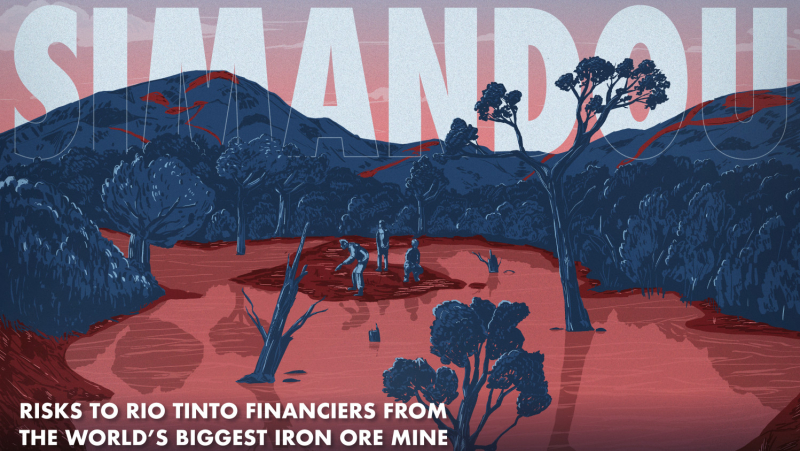
A new briefing by BankTrack and Advocates for Community Alternatives raises serious concerns over banks’ silence and inaction in the face of the widespread impacts of Guinea's Simandou iron ore project, which is being developed in part by mining giant Rio Tinto.
Research for the briefing identified 25 commercial banks with financial ties to Rio Tinto, including USD 29.7 billion in recent general purpose financing and USD 5.1 billion in shareholdings. Almost all these banks failed to show they are acting on the harms caused by the project.
The top three lenders were US banks Citi and Bank of America, and Germany’s Deutsche Bank, which together provided USD 6 billion in financing to the company.
BankTrack shared a draft of the briefing with all banks, requesting information on the human rights due diligence they conducted in relation to the Simandou project, and how they have responded to the risks and impacts identified. While fifteen provided public responses, only one made clear that it had engaged with Rio Tinto on the mine’s impacts. This was Finland-headquartered Nordea, the seventh-largest bank financier of the company. The others only reiterated policy statements, or declined to comment. The remaining ten banks did not provide public responses, although two banks engaged privately with the authors.
Giulia Barbos, Human Rights Campaigner and Researcher at BankTrack, said: “Financing Rio Tinto means financing Simandou, and that comes with responsibility. Where the company is failing to address impacts on people and nature, banks must step in. They should use their leverage to demand action from the company, with consequences for future lending if it does not clean up its act.”
Jonathan Kaufman, Executive Director and Secretary, Advocates for Community Alternatives, said: “From the beginning Guinean communities have been assured that the Simandou project will bring employment, education, and economic development to the country. But our findings show that, rather than funding progress, the banks and investors backing Rio Tinto are instead financing the devastation of local economies and destruction of the environment. Their return on investment should not come at the cost of the survival of impoverished communities.”
For years, communities have reported serious impacts across the project area, which spans an open-pit mine, a 650-kilometre railway and a deep-water port. These impacts include loss of land, destruction of agricultural and fishing livelihoods, and contamination of water sources. (1) Civil society organisations have repeatedly raised concerns about the project’s environmental and human rights risks, yet impacts persist and remain largely unaddressed as the project has now moved into production.
BankTrack and Advocates for Community Alternatives are calling on banks financing Rio Tinto and other project developers to step up their engagement on Simandou’s impacts, in line with their international human rights responsibilities. This includes conducting ongoing and robust human rights and environmental due diligence, actively seeking the views of affected communities beyond company-led processes, and using their leverage – individually and collectively – to press Rio Tinto to improve grievance mechanisms, provide fair compensation for community losses, remediate environmental damage, and prevent further harm.
Endnotes:
(1) A study published by Advocates for Community Alternatives in July 2025, based on sampling and field research in seven communities downstream of the Simandou mine, documented significant water contamination and soil pollution along the railway and in the port area.