Company – Active
This profile is actively maintainedBankTrack
Camila Cabanzo Fracasso, Banks and Steel, camila@banktrack.org
Julia Hovenier, Banks and Steel Campaign Lead,
julia@banktrack.org
Company – Active
This profile is actively maintainedBankTrack
Camila Cabanzo Fracasso, Banks and Steel, camila@banktrack.org
Julia Hovenier, Banks and Steel Campaign Lead,
julia@banktrack.org
Why this profile?
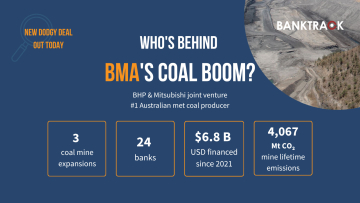
BMA is the third-largest driver of metallurgical coal expansion globally. It is currently planning expansions of three of its metallurgical coal mines in Queensland’s Bowen Basin. If approved, these projects would result in up to 90 additional years of coal production and generate an estimated 4,067 million tonnes of CO₂ emissions. BMA’s metallurgical coal expansion plans raise serious questions about the commitment of its parent companies, BHP and Mitsubishi Development, to their 2030 and 2050 net-zero emissions targets.
What must happen
Banks and financial institutions should end finance for BMA and its two parent companies until they halt their metallurgical coal expansion plans.
| Sectors | Coal Mining |
| Headquarters |
|
| Ownership |
50% BHP Group 50% Mitsubishi Development Pty Ltd Mitsubishi Development Pty Ltd is a wholly-owned subsidiary of Mitsubishi Corporation |
| Subsidiaries |
|
Impact on human rights and communities
Expanding coal mines may violate human rights standards Queensland is “Australia’s most disaster-prone state” according to the Climate Council, with temperatures already rising beyond 1.5°C due largely to the burning of coal, oil, and gas. Communities are already experiencing the impacts through bushfires, cyclones, severe storms, heatwaves, and ocean degradation. In response, the Queensland Government has committed to cutting emissions 75% below 2005 levels by 2035, reaching net-zero by 2050, and closing all publicly-owned coal mines by 2035. In contrast, BHP has not set a 2035 emissions target, creating a gap in near- to mid-term accountability and potentially undermining these public climate commitments. The Climate Council has warned that Queensland’s targets cannot be met without halting approvals for new and expanded fossil fuel projects. Beyond Queensland, the International Court of Justice stated in July 2025 that every state has an obligation to protect the climate system and environment, as failing to do so would constitute a violation of basic human rights. BMA’s three planned mine expansions are in direct contradiction to this.
Emissions from coal mine expansions will intensify Queensland’s climate-driven extreme weather events, which may lead to human rights violations. Continued reliance on fossil fuels, and the resulting increase in greenhouse gas emissions, threaten the right to life and the right to live in a safe, clean, healthy, and sustainable environment for present and future generations.
Human-rights-based litigation challenging coal mine expansions has already succeeded in Queensland. In Waratah Coal Pty Ltd vs Youth Verdict & others, the Queensland Land Court recommended refusing a proposed coal mine lease in the Galilee Basin, finding that its contribution to climate change would unjustifiably limit several human rights under the Human Rights Act 2019. BMA's mine expansion ambitions could face similar litigation risks.
Image: Local protests against mine expansion in Queensland organised by LocktheGate
Increased risk of health impacts for local communities Recent medical studies have identified elevated risks of severe respiratory and circulatory diseases in communities located near coal mining operations in Queensland, while also noting that the full extent of health impacts remains underdocumented due to gaps in research.
On the basis of the right to life, the right to live in a safe, clean, healthy, and sustainable environment, and states’ obligations to prevent climate change and limit its harms, Queenslanders should be protected by their government from the risks posed by coal mine expansions, including those proposed by the BMA Alliance.
Indigenous rights may not be fully recognised All BMA's mines and expansion projects are situated in the Bowen Basin, a land traditionally owned by the Barada Barna Aboriginal community. In 2024, BMA signed the Native Title Project Agreement with the Barada Barna Aboriginal Corporation to formally recognise this traditional ownership.
While the Native Title Agreement represents a necessary acknowledgment of Barada Barna land ownership and offers potential economic benefits, it has significant limitations. The agreement provides formal recognition and economic compensation for land use, but does not protect the community from the human and environmental impacts of the mining projects – particularly in Queensland, a state already highly affected by climate change. Existing mines and planned expansion carry long-term human rights risks, including impacts on health, water, cultural heritage, and intergenerational consent. The Native Title Agreement does not recognise, mitigate, or compensate for these risks.
Impact on climate
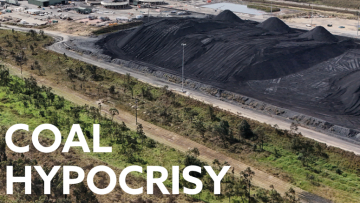
Locking in unsafe carbon emissions The proposed expansions of BMA’s Peak Downs, Saraji East, and Caval Ridge mines would cumulatively add over four gigatonnes (4,067 million tonnes) of CO₂ emissions to the atmosphere over the remaining lifecycle of the projects once they are fully built and operating at expanded capacity. This is equivalent to over ten years of Australia’s total annual emissions, and would consume 2.4% of the world’s remaining carbon budget. Accordingly, these projects have been deemed “Carbon Bombs”, i.e. they are among the 425 projects with more than 1 gigatonne of potential CO₂ emissions, which are therefore a priority to tackle in order to halt climate change.
Despite the massive climate impact of these three projects, BHP and Mitsubishi have not clarified how the expansions align with their climate strategies. BHP, for example, provides limited detail on how emissions from its metallurgical coal assets are expected to decline over time, particularly in light of the planned mine expansions. Both companies claim they are on track to meet their targets, yet around 80% of the emissions from these expansions are either not counted at all or only minimally included, because they are considered “non-operational.”
Additionally, BMA’s planned mine expansions pose a significant climate risk not only through CO₂ but also methane emissions. Methane is a far more polluting greenhouse gas than CO₂, and Queensland, as a major coal-producing region, is already heavily affected by methane pollution. Recent satellite analysis indicates that fugitive methane emissions from coal mines in the Bowen Basin may be around 40% higher than official inventories report. This risk could increase with further mine expansions, especially given the lack of transparency in methane reporting and the absence of a clear strategy for limiting emissions. BHP’s 2025 climate plan does not specify the company’s methane emissions and provides only vague guidance on how reductions will be achieved over the medium term.
Neither company has a credible transition plan BHP’s 2025 annual report states that the company is on track to meet its 2030 target of reducing operational (Scope 1 and 2) GHG emissions by 30%. However, BHP’s decarbonisation plan still heavily relies on blast furnace (BF-BOF) technology combined with carbon capture, utilization and storage (CCUS); has allocated a budget of just US$75 million to steel decarbonisation between FY25 and FY29; and does not prioritise EAF or electric smelting technologies. In contrast, BHP continues to invest heavily in fossil fuel operations, reporting US$500 million expended on coal and coal exploration in FY2025. Additionally, the company lacks a medium-term or reliable decarbonisation strategy for its Scope 3 emissions, although these account for 97% of its total emissions. On this basis, as BHP recognises, the achievement of its 2050 net-zero target remains uncertain.
Mitsubishi has also committed to medium- and long-term net-zero goals for Scope 1, 2, and 3 emissions. However, their definition of Scope 3 only includes emissions from investments. They do not include emissions from producing the goods and services they buy, burning the coal they sell, and the use of their products by customers, which is estimated at 93% of their true scope 3 emissions.
High-quality metallurgical coal: green transition or portfolio greenwashing? BMA presents prioritising higher-quality hard coking coal as both an economic and climate strategy, claiming it reduces emissions intensity in steelmaking. To support this framing, BHP and Mitsubishi cite their divestment of Blackwater and Daunia mines as evidence of a shift toward a lower-emissions portfolio. However, these divestments do not reduce absolute emissions, as both mines continue operating under new owners. As stated by Australasian Centre for Corporate Responsibility (ACCR), “Divesting these two mines to a company which does not support the Paris Agreement serves to undermine global efforts to limit warming."
This framing is further undermined by BMA’s planned expansion of remaining metallurgical coal assets, whose projected emissions exceed those of the divested mines. Emphasising higher-quality coal thus reflects portfolio reallocation rather than real emissions reduction, risking portfolio-level greenwashing.
Reliance on false solutions in steel decarbonisation BHP and Mitsubishi have justified their continued metallurgical coal operations on the expectation that steel industry customers will keep relying on technological solutions such as CCUS, rather than transitioning away from coal.. Under BankTrack’s False Solutions Tracker, these qualify as false climate solutions, as they risk fossil fuel lock-in and environmental damage.
False steel decarbonisation solutions like CCUS are not only a climate risk but also a poor investment. CCUS costs remain high after 40 years, while performance and returns have historically underperformed. In 2023, CCUS captured only 0.2% of global emissions, of which just 2% from the steel sector. Globally, there are only 41 commercial-scale CCUS projects in operation, most in early development, and many may never reach commercial operation. According to ACCR, BHP's heavy reliance on CCUS downplays the transition risks and does not provide investors a clear assessment of portfolio robustness.
Despite this, BHP and Mitsubishi continue to promote CCUS as a reliable decarbonisation strategy, even though investments in proven solutions like green hydrogen would be more effective. Globally, projected CO₂ capture in steel has been revised down from 670 Mt in 2021 to 399 Mt in 2024, while hydrogen-based steelmaking is expected to rise from 29% to 44%. Experts expect CCUS to play an even smaller role in future decarbonisation, with hydrogen and other proven solutions leading the way.
Impact on nature and environment
Deforestation and destruction of koala, greater glider and turtle habitat WWF's 2021 report on global deforestation hotspots finds that nearly half of eastern Australia’s original forest cover has been lost. As a result, more than 700 native plant and animal species are currently threatened. The report attributes Australia’s high deforestation rates not only to land clearing for agriculture, but also to mining, transport infrastructure, and urban expansion. These findings are reinforced by Australia’s State of the Environment report, which identifies Australia as the continent with the highest mammal extinction rate globally. This loss is driven by climate change related disasters, such as rising temperatures, droughts, and bushfires, as well as the large-scale deforestation of thousands of hectares for industrial activities, including coal mining.
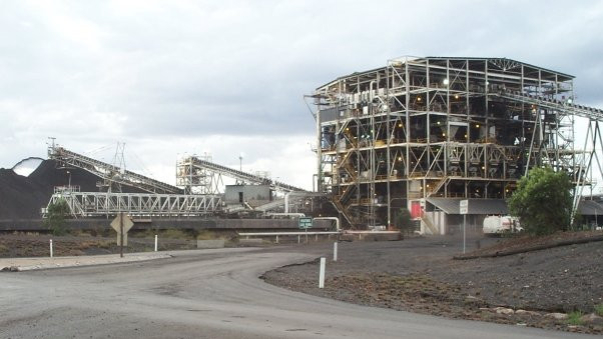
BMA’s three coal mine expansion projects contribute directly to this deforestation trend and pose significant risks to protected species, including koalas and greater gliders. According to the Lock the Gate Coal Mine Tracker, the Peak Downs mine expansion would clear 2,108 hectares of koala habitat, roughly the size of a small town. The Saraji East and Gregory projects would clear a further 1,160 hectares of koala habitat and 748 hectares of greater glider habitat. The Caval Ridge project would primarily affect squatter pigeons, ornamental snake species, and the king bluegrass flora. Its water use may also impact turtle habitats. BMA’s own preliminary assessments acknowledge the potential endangerment of these protected species if the projects proceed.
Threats to water Mining, particularly open-pit mining, can cause significant water contamination due to the large volumes of sediment it generates. As land and rock are excavated, residual material can be washed into nearby rivers and creeks, carrying pollutants and chemicals that degrade water quality, harm vegetation, and disrupt ecosystems. Open-cut coal mines such as BMA’s Peak Downs therefore pose material risks to local water security.
In 2019, BMA was fined US$200,000 for the unauthorised and uncontrolled release of mine‑affected water containing about 3,000 tonnes of silt and sediment into the Isaac River from its Goonyella site in central Queensland in 2017, causing environmental harm. More recently, the Lock the Gate revealed, based on documents obtained under right-to-information legislation, that further unauthorised sediment releases occurred at the nearby Blackwater Coal Mine over more than a decade, up to at least 2022, with runoff from the site entering creeks in the Fitzroy River Basin. The compliance report, accessed by Lock the Gate, indicated that BHP Coal, which held the environmental approvals for the BMA mine, was likely aware of the unauthorised sediment releases and implemented only temporary and insufficient measures to prevent further releases following two formal warnings issued in 2022 by Queensland’s Environment Department.
BMA is a 50:50 joint venture owned and funded by BHP Group Limited and Mitsubishi Development Pty Ltd (a subsidiary of Mitsubishi Corporation). BMA does not issue project‑specific debt or loans. Its operations are financed through the equity contributions and cash flows of its two parent companies. There is no publicly disclosed standalone debt for the joint venture itself or any of its assets.
Banks and financial institutions that provide debt, loans, or underwriting to BHP and Mitsubishi Corporation include major global lenders that have historically financed mining and metallurgical coal companies, such as Mitsubishi UFJ Financial Group, Mizuho Financial Group, Bank of America, Citigroup, HSBC, Barclays, and BNP Paribas. These banks, together with the institutional shareholders of the parent companies (BHP shareholders list, Mitsubishi shareholders list) indirectly support BMA’s capital base through equity.