Banks risk burning forests & fossil fuels for “green” steel
Julia Hovenier, Banks and Steel Campaign Lead at BankTrack, Julia@banktrack.org
Julia Hovenier, Banks and Steel Campaign Lead at BankTrack, Julia@banktrack.org
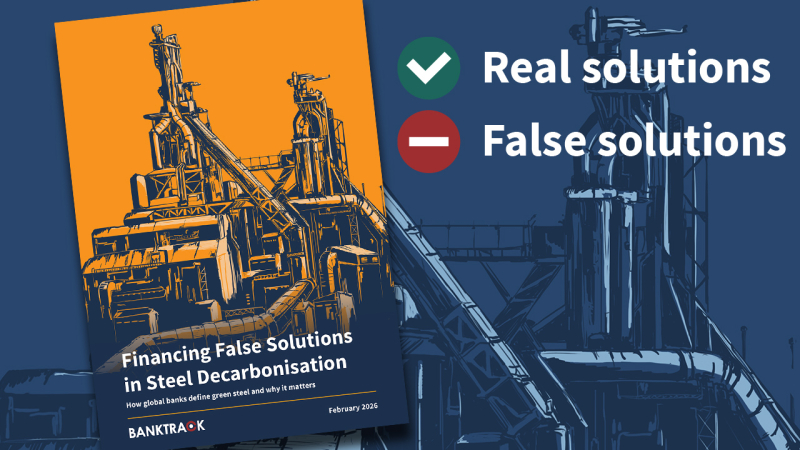
Read our new report here
New analysis from BankTrack reveals that banks are at risk of delaying the global steel transition by allowing ‘green’ finance to flow to environmentally and socially harmful solutions. The report, Financing False Solutions in Steel Decarbonisation, and accompanying tracker, analyse the sustainable finance frameworks of 20 global banks.
Julia Hovenier, Banks and Steel Project Lead at BankTrack said: “Global banks can use sustainable finance taxonomies as incredibly powerful tools. They decide where the billions of dollars pledged at international climate conferences will actually go. Our research shows that currently, there is a huge risk that money for green steel may actually end up going to projects that further lock us into fossil fuels, and keep our air, water and soil polluted.”
Despite commitments from banks to support the steel transition, the research found that banks include several fossil fuel based, or environmentally destructive technologies in their frameworks.
Key findings include:
-
Steel companies are increasingly pursuing false solutions: These are technologies that risk contributing to greenhouse gas emissions, fossil fuel lock-in, deforestation, biodiversity loss, air pollution, and fresh water scarcity. They include gas-based Direct Reduced Iron (DRI), biomass, hydrogen injections in blast furnaces, and offsetting.
-
Several real solutions for decarbonising steel exist: BankTrack considers “real solutions” for steel decarbonisation to include renewables-based Electric Arc Furnaces, green-hydrogen based Direct Reduced Iron (DRI), Molten Oxide Electrolysis (MOE), and demand reduction / material efficiency.
-
Most banks assessed lack clear steel frameworks: There is also significant variability in bank disclosure and clarity: Just seven out of the 20 banks assessed have explicitly addressed steel decarbonisation in their sustainable finance frameworks for steel decarbonisation. Concerningly, out of the top 10 financiers of steel globally, just two – Bank of China and China Construction Bank – have publicly available sustainable finance frameworks for the steel industry.
-
Real solutions are widely accepted, but still lack clarity and essential conditions: Real solutions are widely included in banks sustainable finance frameworks. These include, Electric Arc Furnaces (included in 18 out of 20 frameworks assessed), and green hydrogen-based Direct Reduced Iron (14 out of 20). However just two banks specify that these solutions must be powered with renewable energy, or fully-green hydrogen. Less conventional and technologically ready solutions like Molten Oxide Electrolysis (10 out of 20), and demand reduction (8 out of 20) are less widely included. Some banks, including Commerzbank and BNP Paribas, explicitly include demand reduction solutions.
-
Unproven technologies are included in bank "sustainable" frameworks on a wide scale: For example, 16 banks out of 20 consider Carbon Capture, Utilisation and Storage as part of their sustainable finance frameworks, despite it being unproven at scale. Similarly, most banks (11 out of 20 for each) consider gas-based DRI and biomass to be sustainable.
-
Some banks are first movers on excluding false solutions: Deutsche Bank and Barclays have excluded biomass from their sustainable finance frameworks. Additionally ING and Lloyds, have explicit exclusions for offsetting projects in steel, showing other banks can follow suit.
-
Banks are already exposed to false solutions: Out of the 20 banks examined in this report, 19 are known to be financing companies or projects pursuing false solutions, with Lloyds Banking Group being the only bank that has no identified exposure.
BankTrack is calling on banks to adopt strong sustainable finance frameworks explicitly developed for the steel sector, that exclude false solutions and redirect finance into real solutions, to support the urgent need for a just transition of the steel sector to fossil free by 2050, in line with the Paris agreement.