Major banks providing billions in "sustainable" loans to deforestation-linked companies
Nadia Hasan
Senior Communications Advisor
nhasan@globalwitness.org
Media enquiries
media@globalwitness.org
+44 (0) 7912517127
Nadia Hasan
Senior Communications Advisor
nhasan@globalwitness.org
Media enquiries
media@globalwitness.org
+44 (0) 7912517127
Key findings
- Over 100 banks arranged $31 billion in sustainability-linked loans to palm oil companies despite firms’ alleged links to deforestation
- Standard Chartered and HSBC amongst major banks who together provided half a billion dollars in "sustainability-linked loans" (SLLs) to major palm oil producers Wilmar and Musim Mas, as they faced allegations of corruption and deforestation
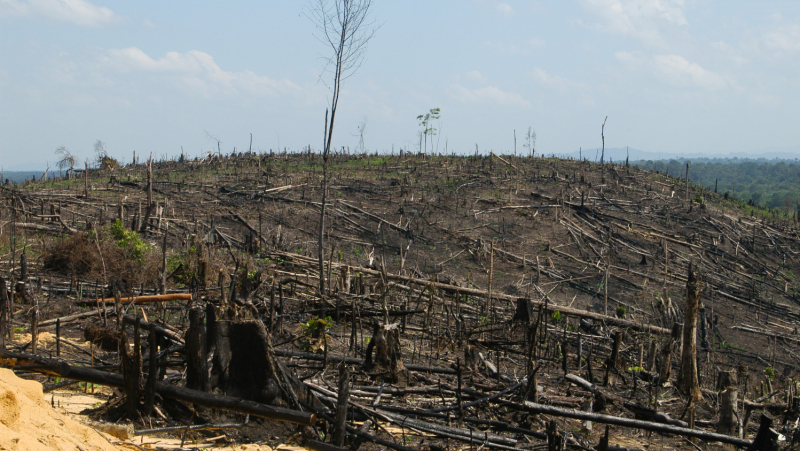
- Data suggests that palm oil producer Wilmar could be linked to 4,200 hectares of deforestation – an area the size of 6,000 football pitches – between 2016-2024, despite introduction of "no deforestation" policy
- Spanning that period (2018 –2024), Wilmar received $950 million in sustainability-linked loan commitments from major banks
Major international banks are handing out billions of dollars in sustainability-linked loan deals (SLLs) to palm oil companies despite links to deforestation, corruption and human rights violations in Indonesia, a new Global Witness investigation reveals today. In some cases, this includes bank re-financing of revolving credit facilities.
Global Witness found that banks including Barclays, HSBC, Crédit Agricole, Rabobank and Bank of China provided billions of dollars’ worth of sustainability-linked loans to palm oil firms while facing allegations of deforestation in their supply chains.
The analysis found that one major palm oil producer in receipt of these loans – Wilmar International – could be linked to primary forest loss in its concessions equivalent to the size to 6,000 football pitches, or the city of Portsmouth between 2016 and 2024, despite introducing a "zero-deforestation" policy in 2015.
Local Indonesian NGOs say Wilmar also forced indigenous communities to hand over their land to the company. Campaigners say the findings expose glaring problems with company-led sustainability reporting and underscore the need for stricter UK and EU regulation on deforestation and sustainable finance.
Flossie Boyd, Global Witness Senior Campaigner, said:
“It is shocking that companies tied to massive forest loss, human rights violations and environmental degradation are seen as ‘sustainable’ investments. Voluntary standards on sustainability allow companies to effectively mark their own homework, raising serious questions for responsible investors. The findings show why the EU and UK need to introduce clear mandatory financial rules that cut off investment to firms failing to tackle deforestation in their supply chains.”
Mbak Tika, Director of YUNI, an Indigenous peoples’ organisation and NGO based in West Sumatra, said:
“Investors need to do due diligence, listen to the voices of the communities that are impacted and ensure that the financing doesn’t empower practices that are problematic – otherwise 'sustainable finance' risks becoming merely a form of legitimacy for land theft and environmental destruction.”
Global Witness also found that between 2022 and 2025, several banks provided a combined half a billion dollars in sustainability-linked loans to Wilmar International and Musim Mas while the companies faced corruption allegations linked to palm oil exports.
The majority of this ($400m) was provided to Wilmar, including a 2023 $200m SLL from Standard Chartered, who in March this year announced that one of their officials was jailed for bribing judges connected to the case.
New Global Witness analysis also reveals that prolific sustainability-linked loan issuers Olam Group and Louis Dreyfus are continuing to buy from suppliers which appear to be linked to deforestation at the same time as receiving billions of dollars of SLL commitments from banks including Barclays, HSBC and Standard Chartered.
"Sustainable" finance
The findings raise serious questions for ESG investors. Global Witness found investors held $46 million in Wilmar shares through 35 funds using terms such as “ESG”, “responsible” or “sustainable” in their titles.
Unlike green bonds, sustainability-linked loans are tied to company-wide sustainability targets set by borrowers and lenders themselves, with no statutory benchmark for what counts as an ambitious target, only voluntary standards.
Despite the UK government’s ambition to position the country as a global hub for sustainable finance, and the Financial Conduct Authority’s claims that transparency in the sustainability linked loan market has improved, the findings of this investigation suggest otherwise.
This investigation builds on previous Global Witness findings that financial institutions made US$26 billion from financing companies accused of deforestation since the Paris Agreement was signed in 2015.
The full report can be accessed here.
Notes to editors
- Global Witness analysed data from Refinitiv Eikon showing loans tagged as "sustainability-linked" to all companies that derive revenues from palm oil in Indonesia, according to Forests and Finance’s segment adjuster methodology. In some cases, this includes bank re-financing of revolving credit facilities.
- Each sustainability-linked loan deal counted in this study was verified via public reporting (e.g via press releases and financial reports) and was put to the companies themselves to corroborate.
- Deforestation figures for Wilmar were accessed via the data provider palmoil.io, using data from Hansen’s Global Forest Change 2000 – 2024 dataset and based on satellite imagery. Palmoil.io filtered the data to only primary forest, 90% canopy density, and peat areas - with planted areas removed as of 2015 onwards to represent deforestation most at risk of breaching NDPE policies (cut-off date 31 December 2015). Global Witness filtered the data to only include concessions where there was clear evidence of ownership or management or control within the period concerned.
- These figures are inferences based on satellite imagery, rather than built on extensive evidence of every hectare of deforestation on the ground. Ultimately, this means where Global Witness identifies deforestation, we assess that there is a high degree of likelihood of deforestation in that area rather than a certainty.
- Wilmar “firmly refute any suggestion that deforestation has been carried out by the company as alleged.”
- All palm oil companies and banks named in the report were contacted by Global Witness. Their responses can be found in the main report.
Re-published from the original press release on the Global Witness website here.