Company – On record
This profile is no longer actively maintained, with the information now possibly out of dateCompany – On record
This profile is no longer actively maintained, with the information now possibly out of dateWhy this profile?
CNOOC is a large oil and gas company. Responsible for high amounts of carbon emissions, CNOOC is actively contributing to climate breakdown.
What must happen
Banks and other financial institutions must demand that their fossil fuel major clients immediately halt all activities that expand fossil fuel infrastructure, and develop and implement credible phase-out plans for their existing fossil-fuel-based activities, on a timescale aligned with Paris Agreement goals. In the absence of such commitments, banks must stop financing CNOOC.
| Sectors | Oil and Gas Extraction |
| Headquarters |
|
| Ownership |
CNOOC is fully owned by the Chinese State via its Assets Supervision and Administration Commission of the State Council (SASAC). |
| Subsidiaries | |
| Website | https://www.cnooc.com.cn/col/col6141/index.html |
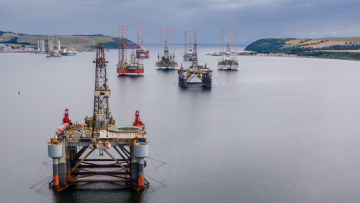
The China National Offshore Oil Corporation (CNOOC), established in 1982, is one of the largest oil companies in China. Via its major subsidiary CNOOC Ltd. the company's activities consist of the exploitation, exploration and development of crude oil and natural gas in offshore China. CNOOC is state-owned by the government of China. In 2021 CNOOC produced 453.7 million barrels of oil and 700.6 billions cubic feet of gas. The company has resources under development amounting to 4225 million barrels of oil equivalent per day (gogel.org).
Impact on human rights and communities
In 2016 Shandong fishermen filed a lawsuit against US oil and gas company ConocoPhillips and CNOOC over impacts on their livelihoods related to the 2011 Bohai Bay oil spill. The oil spill took place in June 2011 at the Penglai 19-3 oil field, which was being jointly developed by ConocoPhillips and CNOOC. Eventually a USD 160 million settlement was reached (Business & Human Rights Resource Centre).
In 2012 CNOOC was accused of participating in the persecution of Falun Gong by collaborating with the Chinese Communist Party to send Falun Gong CNOOC employees to labour camps and mind-control facilities, reducing their pay and preventing them from receiving benefits (or regular wages) unless they renounce their beliefs.
In 2008, CNOOC was accused of human rights abuses in Burma. According to Arakan Oil Watch the company confiscated land and farms, damaged crops and destroyed livelihoods by polluting soil and waterways. Arakan Oil Watch stated in a report that the company "left behind such a trail of abuses and environmental contamination on Ramree Island that outraged locals attacked their facilities".
Impact on climate
CNOOC Ltd. (the flagship subsidiary of CNOOC) plans to reduce its GHG emissions by 16 percent between 2020 and 2025 and aims to peak its carbon emissions before 2030 and achieve carbon neutrality before 2060.
Impact on nature and environment
Bohai Bay oil spill On June 4, 2011 U.S. company ConocoPhillips, operating in the Penglai 19-3 oilfield, caused an oil spill from a seafloor leak which lasted until June 7. This was followed by a second leak on June 17. The leaks polluted a total of more than 840 square kilometers of clean water in Bohai Bay. The Penglai 19-3 oil field is majority-owned by CNOOC (51%), ConocoPhillips owns 49%.
Between 2016 and 2021, 17 commercial banks financed CNOOC via lending and underwriting totalling USD 4.12 billion. See below for more details on banks involved.
In 2022 CNOOC received financing from Bank of China and China CITIC Bank totalling USD 3.378 billion. See below for more details.