Project – Active
This profile is actively maintainedBankTrack & Fair Steel Coalition
Quentin Aubineau, Banks and steel policy analyst and campaigner, quentin@banktrack.org
Project – Active
This profile is actively maintainedBankTrack & Fair Steel Coalition
Quentin Aubineau, Banks and steel policy analyst and campaigner, quentin@banktrack.org
Why this profile?
Ternium’s environmental and social track record in Mexico casts doubt on the company’s claims that its proposed “sustainable” steel plant in Pesquería will contribute to a just transition to fossil-free steelmaking. Its operations in Nuevo León have contributed to significant air pollution, water pollution and CO2 emissions, to the detriment of communities and the climate. There is also a record of attacks on human rights defenders occurring in the company’s supply chain. Additionally, its proposed ‘green’ steel plant relies heavily on fossil gas, and will require new gas infrastructure to be built. This risks fossil lock-in and will create unaffordable GHG emissions.
What must happen
Banks that have supported the Pesquería plant must publish the green finance criteria they used to assess the eligibility of the plant for green lending, and monitor the environmental and social impacts of their loan through consultation with communities affected by the project. This includes both the rural and urban areas within the municipality of Pesquería, and the rest of the metropolitan population of Monterrey.
Furthermore, banks must require Ternium to publish a clear roadmap for replacing fossil gas with green hydrogen by 2035. Banks must not finance new or expanded fossil gas infrastructure linked to the new steel plant. Finally, banks must exclude steel production using gas and carbon capture from their sustainable financing frameworks.
| Sectors | Iron and Steel Manufacturing |
| Location |
|
| Status |
Planning
Design
Agreement
Construction
Operation
Closure
Decommission
|
| Website | https://mx.ternium.com/es/nuevas-inversiones |
Ternium is a Luxembourg-based steel company and the largest steel producer in Latin America. Its subsidiary, Ternium Mexico, received a green loan to construct a new gas-based steel plant to expand its existing industrial centre in Pesquería, Mexico.
Ternium Mexico operates eight steel plants in Mexico (including Planta Ternium Guerrero, Ternium Apodaca, and Ternium Puebla), with Pesquería being the most recent addition. Initial facilities for steel finishing were constructed in 2013, and with this new project, construction of a steel manufacturing plant is projected to begin in the fourth quarter of 2026.
The new steel plant will consist of an electric arc furnace (EAF)-based steelmaking facility with annual capacity of 2.6 million tons, as well as a gas-based direct reduced iron (DRI) module with annual capacity of 2.1 million tons. It is being developed to serve companies from the automobile manufacturing sector such as Kia and Hyundai in Mexico. Ternium has a decarbonisation roadmap and claims that the new plant in Pesquería is a key part of its climate action plan.
Impact on human rights and communities
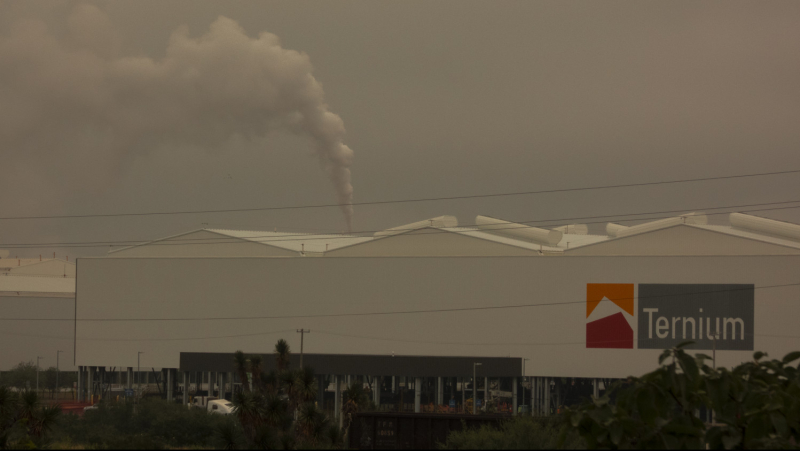
Air pollution in Monterrey is already above safe levels Ternium’s Pesquería plant will be located right next to the metropolitan area of Monterrey. If constructed, it would contribute to an ongoing public health crisis in Monterrey. A recent study ranked Monterrey as the metro area with the worst fine-particulate air pollution in North America. While other cities have managed to reduce the levels of contamination, they remain particularly high in Monterrey, leading to thousands of deaths per year in the area.
The government estimates that 60% of this pollution comes from industrial emitters. The location of most of these industrial sites in populated areas increases the health risks. For instance, Ternium’s Largos Apodaca plant is the industrial site with the highest lead emissions in Monterrey, which can cause brain damage in children. Likewise, the Ternium Guerrero plant is located just a few metres from Ciudad Universitaria, in the municipality of San Nicolás. A community study found that students at the Autonomous University of Nuevo León were suffering from persistent allergies, as well as widespread anxiety over the fear of developing illnesses in the medium term.
Ternium already features among the most polluting companies of Nuevo León A 2026 report by Mexico’s Ministry of Environment and Natural Resources listing 189 contaminant-emitting companies in the State of Nuevo León mentions Ternium more than any other company, with 24 references covering the seven plants it operates in the state, including the Pesquería plant. Research based on 2023 data found that Ternium was one of the companies emitting the most lead, cadmium, and arsenic in Nuevo León, and also unsafe levels of nickel, methylene diphenyl diisocyanate. According to the World Health Organisation, the adverse effects of these contaminants on human health include kidney-related diseases, lung cancer, and child neurodevelopmental delays. Despite this, they have been emitted by Ternium’s plants in Nuevo León for more than a decade. Investigations indicate that Ternium’s waste also includes hexavalent chromium. This pollutant is strictly regulated in the U.S. due to its high toxicity and carcinogenicity, but outdated federal law in Nuevo León does not set specific limits for hazardous waste treatment, leaving the responsibility to companies. In September 2025, Congress approved an appeal for Mexico’s Secretary of Health to conduct clinical studies on all residents living near Ternium’s operations. Ternium should not be allowed to expand its operations without first cleaning up its operations in Nuevo León.
Ternium’s supply chain is linked to attacks on human rights defenders Ternium’s steel plants in Mexico are supplied by the company’s own iron ore mines. These include the Peña Colorada and Aquila mines, located in indigenous Nahua communities in Mexico. According to local and international NGOs, community leaders that challenge these mines’ interests have been threatened, killed or disappeared. In its 2025 report, the United Nations Working Group on Enforced or Involuntary Disappearances has documented violence against human rights defenders in Mexico, where it highlighted its concern regarding the disappearance of Ricardo Lagunes Gasca and Mr Antonio Díaz Valencia, in connection with their legitimate defence against mining activities. The authorities have allegedly failed to investigate whether their environmental activism was a motive in their disappearance. In its 2024 Annual Report, Ternium stated that “if violence and conflict persist or escalate in the regions where Ternium has its mining operations, Ternium’s mining activities in Mexico may be partially or totally suspended, or even permanently shut down.” However, despite these commitments, the company has continued its operations, while an investigation has reported that the crimes committed against community leaders have not been solved, and violence has increased in the areas where the company operates.
Impact on climate
Insufficient climate transition plan In February 2021, Ternium announced its first group-level decarbonisation roadmap, with a target to reduce CO₂ emissions per ton of steel by 20% by 2030 compared to a 2018 baseline. In July 2025, the company revised its 2030 target “to reduce emission intensity by 15%, now including Scope 3 emissions (categories 1 and 10) in addition to Scopes 1 and 2 compared to a 2023 baseline”. Ternium also makes it clear that achieving its climate goals is conditional on “technological viability and market conditions.”
According to its Environmental Impact Assessment (EIA), the Pesquería steel plant will have an operating lifespan of 50 years. Since it is expected to be commissioned in 2026, it could operate until 2076. However, Ternium still does not have a science-based and time-bound target to achieve Net Zero by 2050. Consequently, there is no climate plan sufficiently covering the operation of this new plant, nor any guarantee that Ternium will align its activities with international climate goals.
False solutions in steel decarbonisation The Pesquería plant is cited as crucial for Ternium’s 2030 decarbonisation roadmap, but it is reliant on false solutions in steel decarbonisation: gas and carbon capture. The project will develop Direct-Reduced Iron (DRI) - Electric Arc Furnace (EAF) technologies that will be equipped to transition from gas to green hydrogen “once it becomes economically viable – looking ahead to post-2030 alternatives”. In practice, this means the plant will use fossil gas, and there is no plan to transition to green hydrogen. We consider this project a false solution because:
Carbon Capture is ineffective: There is only one commercial-scale gas DRI + carbon capture plant operating in the steel sector: Al Reyadah CCUS in the UAE. According to that plant’s own disclosure of its emissions, the plant captured less than 20% of its total Scope 1 and Scope 2 emissions in 2020 and 2021. This percentage rose to 26% in 2022; however, this was only attributable to a greater proportion of clean electricity used in the total electricity consumption mix – leading to a reduction of scope 2 emissions, not an increase in the emissions captured.
Methane leakage: Additional gas in Ternium's supply chain will come with additional methane emissions and leakage, a climate pollutant 80 times more potent than CO₂ over a 20-year period. In its latest 2024 Sustainability Report, Ternium states that methane emissions are included within its Scope 1 emissions (16.2 million tCO₂e). However, it does not provide a breakdown of methane emissions in absolute terms, nor does it specify whether methane leakage rates have been separately quantified. This is problematic because, as the nonprofit RMI reports, “methane leakages drive emissions parity between gas and coal, especially through the gas supply chain”.
Fossil lock-in: The EIA states [PDF, page 178] that there are currently no clear alternatives to gas for reducing carbon emissions from steel production, although alternatives related to hydrogen use in the process are being analysed. Ternium has invested in research and development of “turquoise hydrogen” (a form of fossil-gas-based hydrogen). According to the IEA, this production pathway remained marginal in 2024. Ternium has said of its operations in northwestern Mexico that “perhaps” in the midterm, hydrogen could be blended with gas and, in the long term, could eventually substitute 100% of gas inputs, depending on market conditions. However, a 2023 report highlighted that the principal challenge for the development of green hydrogen in Nuevo León is the availability of cheap gas from Texas and the “grey hydrogen” produced from it, calling into question Ternium’s business case.
It’s unlikely that Ternium will actually switch to green hydrogen: In its Sustainability Report 2024, Ternium indicates that it needs to “identify and develop economical and scalable technologies that will enable further decarbonisation” of its operations beyond 2030. One example is Ternium’s participation in a pilot plant to produce turquoise hydrogen through methane pyrolysis. It is inconsistent for Ternium to invest resources in turquoise hydrogen while acknowledging that green hydrogen is the most promising alternative for DRI processes.
Expanding gas infrastructure: In order to supply the new DRI with gas for iron ore reduction, and generate enough electricity to run the new EAF, Ternium’s EIA proposes building a new gas power plant and expanding at least one gas pipeline. The Pesquería site is already supplied with electricity from Techgen’s gas-based power plant. Building the new plant could double the plant’s gas consumption for electricity, to 353,960 standard cubic metres per hour (Sm³/h). Investments in this infrastructure will create an incentive to maintain cheap fossil gas supply instead of switching to green hydrogen as soon as possible. As Agora Industry says, “the emission reductions stated for breakthrough technologies vis-à-vis the conventional route can only be achieved if low-carbon electricity and hydrogen are used”.
Impact on nature and environment
River contamination In June 2025, Ternium was found guilty of spilling polluting substances, including ferric chloride and acidic water, in the La Talaverna stream in Nuevo León. The spill took place in April 2025 at Ternium’s plant in Churubusco. The company was fined 6.6 million pesos (roughly EUR 330,000) by the National Water Commission (CONAGUA) for the environmental damage. Media described the spill as an “ecocide” to the stream's flora and fauna. CONAGUA’s resolution cites “discharge due to improper operation of the infrastructure and a clear failure to apply the established protocols for the handling of highly polluting substances and/or waste used and generated in the company's own industrial processes”.
This incident highlights Ternium Mexico’s inability to manage and mitigate environmental risks. Furthermore, the accumulation of industrial discharges could negatively impact local ecosystems, as the company stated in its Environmental Impact Assessment, in which it asserts that any wastewater that cannot be treated will be discharged into the Pesquería River. The expansion of Ternium’s plant in Pesquería, which includes the construction of an aqueduct to discharge wastewater in the Pesquería River, is only likely to worsen the situation.
Future environmental impacts According to the environmental impact assessment (EIA) for the Pesquería plant, the project will significantly affect air, hydrology, fauna and vegetation during its different phases. For example, the company stated that it will undertake 32 activities that will have hydrological impacts on the Pesquería River.
The EIA lists various preventive and mitigation measures to avoid or limit these impacts. However, these measures seem insufficient to prevent potential significant environmental impacts during the development and operation of the new plant, particularly considering Ternium’s poor track record.
Impacts on wildlife The EIA for the Pesquería plant states that “the results obtained in the evaluations carried out show that wildlife is still present in the area, despite industrial activities, mainly in its green areas and gardens, serving as a wildlife corridor to neighbouring lands that still have good vegetation cover, which provide food, shelter, and areas for reproduction and movement”. This wording implicitly acknowledges adverse impacts on wildlife in the area without quantifying them. The EIA lacks baseline data on wildlife populations against which to measure change – a fundamental requirement for a credible impact assessment.
Ternium plans to invest $4 billion into the Pesquería industrial centre. Ternium Mexico issued a $1.25 billion “green loan” in December 2025, to finance the “design, construction, operation, and maintenance” of the plant. Natixis, BNP Paribas and Crédit Agricole CIB coordinated the loan issuance, and Natixis was also administrative agent for the loan facility. The three banks were also joint leads and bookrunners, together with Citigroup, Intesa Sanpaolo, JPMorgan and Mediobanca. The loan’s Green Financing Framework received a “Medium Green” rating from S&P Global Ratings. This rating means that the project represents a significant step towards a low-carbon, climate-resilient future but requires further improvements to be a long-term low-carbon, climate resilient solution.
Ternium is a Luxembourg-based steel company and the largest steel producer in Latin America. Its subsidiary, Ternium Mexico, received a green loan to construct a new gas-based steel plant to expand its existing industrial centre in Pesquería, Mexico.
Techgen S.A. de C.V. is a Mexican gas-fired combined cycle electric power plant in Pesquería that was commissioned in December 2016. It is currently owned 48% by Ternium, 30% by Tecpetrol and 22% by Tenaris. Tecpetrol is the wholly owned subsidiary of San Faustín SA, the controlling shareholder of Tenaris and Ternium. Ternium and Tenaris contracted 78% and 22% of Techgen’s power capacity of 900 megawatts respectively. According to Ternium, Techgen covers most of its Mexican facility’s electricity needs, including its industrial centre in Pesquería. Ternium anticipates a potential expansion of the power plant to supply its new steelmaking facility.
Applicable norms and standards
-
Environmental and Sustainability Framework
-
LGEEPA (General Law of Ecological Equilibrium and Environmental Protection), which was amended on 19 January 2026 to incorporate principles of the circular economy.
-
General Law on the Circular Economy (New): Requires high-impact industries, such as the steel industry, to implement shared responsibility plans, prioritising the recycling of scrap metal and the recovery of slag.
-
General Law for the Prevention and Comprehensive Management of Waste (LGPGIR): Regulates the generation and management of hazardous waste (such as sludge or steel mill dust).
-
NOM-001-SEMARNAT-2021: Sets much stricter limits for the discharge of wastewater into receiving bodies. For a ‘sustainable’ plant, compliance with acute toxicity and true colour parameters is required.
-
National Water Law: Required for the granting of extraction concessions and compliance with the reuse standard (NOM-003-SEMARNAT-1997).
-
Single Environmental Licence (LAU): This is the mandatory procedure with SEMARNAT that coordinates the assessment of environmental impact, atmospheric emissions and waste generation.
-
Human Rights and Due Diligence
-
Article 1 of the Constitution: Requires all companies to respect human rights.
-
Amparo en Revisión 688/2024: The Supreme Court of Justice has begun to incorporate the climate variable as a mandatory consideration. It has highlighted the need to advance the regulation of greenhouse gas emissions as a measure to guarantee the right to health and a liveable future, which puts pressure on heavy industry to present verifiable decarbonisation plans before the courts.
-
Constitutional Appeal 304/2018 (Laguna de Carpintero Case): This ruling is historic because it establishes that where there is doubt regarding significant environmental damage, authorities and companies must halt or modify the project (precautionary principle). For a steelworks, this means that the lack of evidence of damage is no excuse for failing to implement advanced mitigation measures.
-
Constitutional Appeal 435/2025: Standing to bring proceedings has been strengthened, allowing anyone living in the surrounding area of an industrial project to challenge it if they consider it affects their right to a healthy environment, without needing to demonstrate direct financial loss.
-
Corporate Due Diligence: Although still in the process of legislative consolidation for 2026, the courts already require companies to identify and mitigate adverse impacts on human rights (the right to water, health and a healthy environment) throughout their value chain.
-
Specific Technical Regulations (NMX and NOM)
-
NMX-AA-164-SCFI-2013: Minimum environmental criteria and requirements for sustainable building in Mexico.
-
NOM-002-SEMARNAT-1996: Limits for the discharge of wastewater into urban sewerage systems.
-
NOM-085-SEMARNAT-2011: Maximum permissible levels of emissions of indirect fired combustion equipment and their measurements.
-
Binding International Instruments
-
Escazú Agreement: Mexico is a party to this treaty, which guarantees access to information, public participation and justice in environmental matters. For a steelworks, this means that Environmental Impact Assessments (EIA) must be transparent and participatory from the earliest stages.
-
CBAM (Carbon Border Adjustment Mechanism – EU): Although it is a European regulation, it functions as de facto international law for exporters. It imposes a ‘carbon tax’ on steel that does not demonstrate decarbonisation processes, thereby linking sustainability directly to commercial viability.
-
Key Regional and International Case Law
-
Advisory Opinion OC-23/17 of the Inter-American Court of Human Rights: Established that the right to a healthy environment is an autonomous right.
-
Advisory Opinion OC-32/25 (Climate Emergency) of the Inter-American Court of Human Rights: Defines that States must regulate companies (including steel producers) to ensure that their decarbonisation plans are substantive, timely and effective, and that climate inaction violates the right to life and physical integrity. It includes an increased duty on the part of companies to tackle climate change, particularly if their contribution to climate change is high.
-
KlimaSeniorinnen v. Switzerland (ECHR, 2024): The European Court of Human Rights ruled in this judgment that the inadequacy of measures to mitigate climate change violates the right to private and family life.
-
Advisory Opinion of the International Court of Justice (2025): This emphasises that States have a legal obligation to prevent significant damage to the climate system, thereby reinforcing regulatory pressure on high-emission industries, such as the steel industry.
-
Corporate Due Diligence Standards
-
UN Guiding Principles on Business and Human Rights (UNGPs).
-
OECD Guidelines for Multinational Enterprises on Responsible Business Conduct.
-
OECD Guidance on Due Diligence for Responsible Supply Chains of Minerals from Conflict-Affected and High-Risk Areas.
-
Other relevant documents