
“Strengthening democracy” or strengthening the Kremlin? How Raiffeisen uses sponsorships to hide from accountability
In July, Austria’s Raiffeisen Bank International (RBI) will come under new leadership. As CEO Johann Strobl steps down from his nine-year tenure, the reins will be taken over by Michael Höllerer, a member of the bank’s supervisory board and a longstanding senior executive in the wider Raiffeisen Group’s domestic outfits.
Höllerer will now be in charge of solving RBI’s chief reputational dilemma: its continued presence in Russia, where it operates the largest foreign financial institution by far. Since Russia’s full-scale invasion of Ukraine began in February 2022, the bank has been marred by controversy over its continued and well-documented links to the Russian economy and state, facing parliamentary inquiries in Austria, sanctions probes from US authorities, and widespread criticism from civil society.
All eyes are currently on Höllerer to develop a “credible plan to exit Russia”. But he is unlikely to find quick solutions to RBI’s Russia problem: the bank’s leadership claimed as recently as September 2025 that its plans to sell the Russian subsidiary are no longer in their hands, and RBI still refuses to eat the losses required to fully wind down its Russian business even as pressure has mounted.
Buying time - sponsorships and RBI’s PR strategy
Where Höllerer is more likely to make an impact, however, is on the bank’s reputational strategy. A reported chief pioneer of the Raiffeisen Group’s domestic media strategy, Höllerer spent his time in the group’s Raiffeisen Holding buying up several of Austria’s largest newspapers and media outlets and expanding the group’s connections to key cultural institutions. He is widely viewed as the central figure in renewing the bank’s “sociopolitical influence” in Austria.
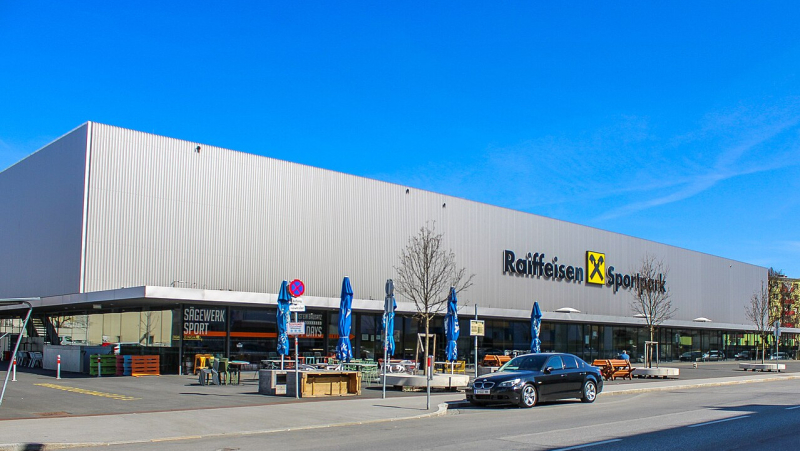
In recent years, this influence has been particularly visible in the Raiffeisen Group’s extensive sponsorship programme. The group has excelled at developing branding opportunities across Austria and Eastern Europe, attaching its name to reputable events and institutions with large public exposure. Any encounter with Austria’s cultural or sporting sector will likely yield an encounter with Raiffeisen’s yellow-black “Giebelkreuz” logo: it appears at music festivals, in museums in Vienna, and on the uniforms of athletes across the country.
Höllerer comes to RBI – the Raiffeisen Group’s international affiliate – at a time when the bank has shown an interest in developing a large sponsorship portfolio of its own. On its website, the bank claims that this programme is founded in respect for “strengthen democracy the rule of law” – a dubious claim from a bank with close ties to Putin’s war economy. Through its sponsorship programme, RBI has successfully attached its name to, among others:
-
Vienna’s ALBERTINA Museum, one of the largest modern art museums in the world, where RBI regularly sponsors new exhibitions;
-
The Vienna Philharmonic Orchestra, whose annual Summer Night Concert draws crowds of over 100,000 people to Schönbrunn Palace and prominently displays RBI’s logo;
-
The European Handball Federation (EHF), which runs a series of collaborations with RBI and will be hosting the “Raiffeisen Bank EHF Final” in 2026;
-
The International Ice Hockey Federation (IIHF), which has run its World Championship under an RBI sponsorship since 2007;
-
The Vienna State Opera, which regularly stages productions that feature RBI as a sponsor;
-
The Tyrolean Festival in Erl, where RBI attaches its name to prominent classical music performances;
-
The Austrian National Library, for whom RBI acts as a cultural partner.
By associating some of Austria and Eastern Europe’s most prominent cultural and sporting institutions with the Raiffeisen brand, RBI has developed a sophisticated reputational strategy. That strategy has become particularly useful as the bank’s Russia problem has grown over the last three years. Despite mounting pressures, RBI has excelled at deflecting from the outrage over its Russian operations and warding off real consequences: domestic media has rarely reported critically on the bank (with some honourable exceptions), widespread public calls for an exit from Russia have so far gone unanswered, and Austrian government officials went to great lengths to have the bank removed from a Ukrainian “sponsors of war” list. The bank’s continued ability to prevent serious reputational fallout has depended in no small part on its ability to present itself publicly as a supporter of culture, diversity, and democratic values, using culture and sport as a smokescreen behind which it continues to supply Russia’s war economy with crucial services and revenues.
Resisting culture-washing
As RBI enters new leadership under Höllerer, these sponsorships may lead some of Austria’s largest cultural institutions to involuntarily help shield RBI from reputational damage over its presence in Russia. Colleagues have spoken openly about Höllerer’s ambitions as a “power player” who could expand the bank’s role in public life. With outrage mounting over the bank’s continued failure to leave Russia, a skilled new PR player at the helm could help bolster the bank’s reputation.
However, Höllerer himself has shown no public interest in quickly winding down the bank’s business activities in Russia. If previous indicators are anything to go by, he is likely to keep buying time, relying on links to sponsorship benefactors and a strong presence in the media world to deflect from criticisms over Russia.
The question is: will the cultural sector let him? RBI’s partners in the cultural and sporting world are reputable organisations which represent the very values RBI undermines through its operations in Russia. In previous years, conflicts like these have led several cultural institutions to sever their ties with complicit sponsors. As RBI enters new leadership and tries to ramp up its PR management, these organisations should consider whether they want to continue providing RBI with branding opportunities – or whether Russia is a red line they will not cross.