Papua LNG: final investment decision due amid Indigenous rights scandal
Shona Hawkes, Director Land and Environmental Justice at Jubilee Australia, shona@jubileeaustralia.
Shona Hawkes, Director Land and Environmental Justice at Jubilee Australia, shona@jubileeaustralia.
In mid-October, TotalEnergies – after over a decade leading the controversial Papua LNG project – reduced its stake and handed over operatorship to ExxonMobil.
TotalEnergies appears to retain control over the project’s upstream, other project co-venturers are Santos and ENEOS.
Around this time, three export finance agencies – JBIC, NEXI and US Exim Bank – published environmental and social impact assessment documents for Papua LNG and invited feedback as part of their official due diligence process, signalling willingness to consider financing the project.
Yet there’s a problem.
Papua LNG will impact 220+ clans and 63,000 people. The project faces ongoing controversies and doesn’t yet have the Free, Prior and Informed Consent (FPIC) of landowners.
This article seeks to examine 10 key points on FPIC and Papua LNG. Developments are fast evolving.
1. Clans and PNG Indigenous Peoples’ rights experts are speaking out
Papua LNG has accumulated a host of FPIC controversies it appears to have no intention of addressing:
-
In July 2026, eleven gasfield clans publicly withdrew from the FPIC process, telling TotalEnergies’ they believed the process was violating their customary rights, and potentially “unlawful” and “unjust”. They called for an investigation into the consultants and called for a new FPIC process. They claimed the FPIC process failed to meet internationally recognised standards requiring consultation to be free from pressure, conducted before major commitments are made, and based on full and accessible information.
-
For years, dozens of clans have stated that they should be recognised by the project as impacted landowners. Recognised landowner clans, provincial leaders and MPs have also called for ongoing concerns about landowner identification to be resolved.
-
At least one legal action contesting the project advancing without first resolving landowner identification issues is reported, lodged by the Purari Development Association.
-
The project has already undertaken land clearing and drilling without FPIC in earlier stages of the project for years. In April a clan representative raised this directly to Santos’ board at its AGM.
-
In October 2026, an open letter to ExxonMobil endorsed by 8 Papua New Guinea (PNG) NGOs called for the company to publicly release the MOU agreements that clans are being asked to sign, make key documents public and respond to landowner concerns. The letter came from the Centre for Environmental Law and Community Rights Inc. (CELCOR), one of PNG’s best known legal organisations with a long history of legal casework and advocacy on customary landowner rights.
-
In December 2025, six organisations filed a complaint to the Equator Principles that detailed extensive FPIC breaches. TotalEnergies did publish a short response, which fails to substantively address issues raised.
-
The head of the Papua Native Landowners Association Inc has also spoken out on FPIC describing gasfield clans’ withdrawing from FPIC processes as a “wake up call for every Indigenous community impacted by the Papua LNG project”.
-
Throughout October and November, a broad coalition of landowners from Gulf province - where the project’ upstream will take place - have called for issues including landowner recognition, environmental damages and transparency to be addressed. This brings together concerns of the Upstream project-affected landowners, representing the wellhead, truckline and central processing facilities, as well as the mid-stream pipeline project-affected landowners, comprising the north, mid and south pipeline segments.
-
The Gulf provincial government has issued a 14-day ultimatum on 13 key conditions to be addressed, on which its support is based. This includes issues raised by landowners.
2. FPIC is determined under specific rights frameworks and articulations
The foremost international agreement on FPIC and Indigenous Peoples’ right to self-determination that it sits within is the 2007 UN Declaration on the Rights of Indigenous Peoples (UNDRIP). The UN Guiding Principles on Business and Human Rights (UNGPs), the OECD Guidelines and various other laws, treaties or standards referencing human rights also relate to UNDRIP.
Human rights are referenced by the French Duty of Vigilance which applies to the international operations of large French companies and their subsidiaries, such as TotalEnergies’ activities in PNG.
The Equator Principles complaint document outlined in detail how the project breaches at least 6 of the 10 Equator Principles, and at least 4 related International Finance Corporation Performance Standards (IFC PS). Both standards include partial recognition of Indigenous Peoples’ rights but also allow for rights breaches. The complaint documented project breaches of FPIC under both and extensively discussed violations of FPIC as a human right. A year later, allegations remain current.
FPIC has a clear jurisprudence evolved through international and national law, as well as precedents through non-judicial grievance mechanisms such as the OECD and IFC.
In June 2026, drawing on UNDRIP, the UN working group on business and human rights (hereafter UN working group) provided a clear report and guidance on companies and FPIC. Papua LNG is clearly in breach of this advice.
|
Practical understanding of FPIC From UN working group, June 2026 report |
|
1. Free: no undue influence, coercion, intimidation, militarization, manipulation, bribery, fabricated consent, or retaliation or reprisal for no consent decision; and safe participation. |
|
2. Prior: before decisions are made, before permits, concessions or licenses are granted, before contracts are signed, surveys conducted, land entered or any business activities commenced. |
|
3. Informed: full, understandable, accurate information, in Indigenous languages and accessible formats that incorporates Indigenous knowledge. |
|
4. Consent: a collective and independent decision made through Indigenous Peoples’ own institutions or mechanisms or processes agreed by them. The collective decision includes the right to say yes, no, or yes with conditions, and to revisit consent if conditions are violated or the context changes. |
3. The project cannot show “informed” consent
Landowners, PNG NGOs and many others, are continuing to call for basic documents about the project to be made public, including:
-
Social mapping and landowner studies
-
The specific location and sites of project infrastructure
-
Indigenous Peoples Framework
-
Full Environmental Permits
-
Resettlement Plans
-
Decommissioning Plans
-
All environmental assessments
-
Template “FPIC MOU”
-
Full Upstream Human Rights Impact Assessment
-
Full Downstream Human Rights Impact Assessment
-
Climate Change Risk Assessment
-
Economic modelling of impacts for landowners
4. FPIC misinformation
Papua LNG has also manufactured a situation where there is no public record of what information it provided at community level about the project’s risks, impacts and their rights. Many impacted communities are remote.
So far, the only exceptions appear to be a pamphlet on a company grievance mechanism and another on marine transport risks.
Was information provided misleading? Incomplete? Incorrect? Confusing? Biased?
Who knows. There is no public record. The FPIC investigation clans have called for could have enlightened. The project has engineered an environment rife for abuse. It could have videoed the presentations made by its staff and put these online, published the images shared, made complementary social media videos, radio programs or community booklets. It chose not to - and the public should ask why.
Buried in a 2022 sustainability report is this photo. After years of searching, this is the closest anyone’s come to documenting community information provided on FPIC.
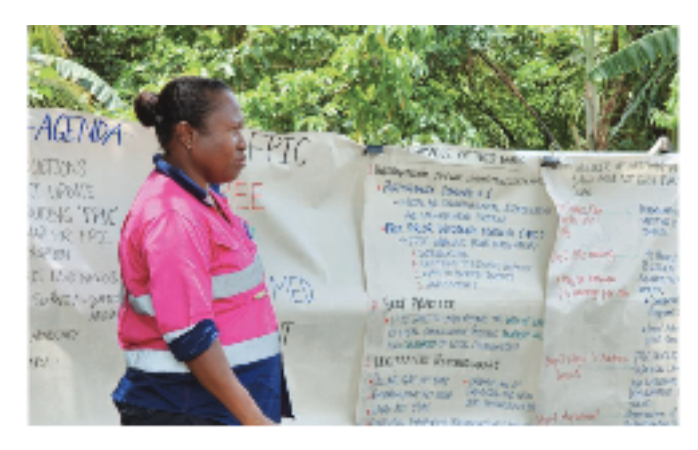
The poster describes the steps to FPIC as:
-
Introduction
-
Meeting to discuss impacts
-
Ways to address impacts
-
Agreement
It says nothing of clans’ right to say “yes” or “no” to a project, “no” until certain conditions are met or to withdraw consent. This is the crux of FPIC. This poster would reasonably mislead people to think that FPIC affords them no specific rights.
5. The project cannot show “prior” consent
Consent is not FPIC if key project decisions are already made. Papua LNG has repeatedly breached this “prior” requirement.
Without FPIC, it has undertaken:
-
Land access, waterways access, land clearing and other activities in the FEED and pre-FID period
-
Applying for, and being awarded, environmental permits
-
Supported the Development Forum (negotiations about royalties etc)
-
Applied for a multi-billion-dollar loan and provided final environmental and social reports to potential financiers
6. Unpacking the project’s so-called “FPIC” processes: Breaching “consent” requirements
At a glance, the 553-page Upstream Environmental, Social and Health Impact Assessment synthesis report (ESHIA) provided to financiers is full of detail and refers to a range of processes. However, scratch the surface of this September 2026 document and it appears differently.
On FPIC, the ESHIA refers to “FPIC processes”, “FPIC implementation”, a “FPIC status register”, notes from “FPIC meetings” and a “template FPIC agreement”. There’s even a flow chart. There is a lot of describing internal processes that cannot be publicly verified or contested in lieu of showing actual FPIC - because the project can’t. Reading between the lines offers a very different perspective on FPIC processes.
This appears to involve at least four steps:
a) Secret studies written by companies
Landowners and impacted people are identified through social mapping and landowner identification studies. Who conducts these? Companies themselves. The studies are not made public. There is no way for independent experts to confirm if they are legally or human rights compliant. That studies were given to the PNG government offers no guarantee of compliance, as it has failed to act on various land rights scandals.
b) Secret processes to decide whose FPIC is or isn’t sought
Papua LNG divides its approach to affected Indigenous Peoples into two categories. Those it seeks FPIC from and those it does not, the latter known as Informed Consultation and Participation (ICP).
There is no public list showing the 220+ clans and their status on if the project views it requires their FPIC or not. There’s a reference to FPIC being triggered by IFC PS, without reference to UNDRIP which is the necessary human rights requirement.
Indigenous rights experts cannot review if individual decisions applying ICP rather than FPIC comply with human rights or even lesser IFC PS standards. There’s no visibility on if the approach is consistent or fair.
Papua LNG will affect 63,000 Indigenous People. How many won’t be asked for their consent?
c) Secret “FPIC MOUs” drafted by the project
A newly published project document reveals that the project has a “template FPIC agreement” also called a “FPIC MOU”. Clans are then asked to sign a FPIC MOU.
How many clans have signed, withheld or withdrawn their FPIC isn’t clear.
For FPIC to be achieved, it has to meet a specific standard. Calling something a “FPIC MOU” doesn’t make it FPIC compliant. In fact, if a MOU includes obligations onerous to clans, such as extremely vague terms on what a company is allowed to do on their traditional lands or waterways, this could be evidence of human rights violations. PNG NGOs have called for the template FPIC MOU to be made public. Best practice for FPIC negotiations is where communities themselves propose their protocols, processes and terms.
d) “Independent legal advocacy” = Clans should use lawyers paid for by the project
In the ESHIA, TotalEnergies resurfaces claims that clans are supported by “independent legal advocacy”. Elsewhere the company states that this is so communities understand their “rights and obligations” and refers to “third party legal advisors”.
As Equator Principles complainants highlighted, these are lawyers hired by the project. Who would knowingly trust lawyers paid by the company that you are negotiating with for legal advice? No one - the lawyers are not even publicly named. Recognised landowners, NGOs and others have highlighted the need for landowners to hire their own legal counsel. Yet, neither the government nor the project provided landowners funds to hire their own legal counsel or other technical experts.
The UN working group also notes that access to independent experts may be required for FPIC. Financial support is key as many clans live largely outside the monetary economy. If the project is travelling into remote communities for a short consultation, urging clans to sign a MOU that the project itself has written, accompanied by lawyers that it describes as “independent” but who are not contractually required to represent clans’ interests – this is likely to manufacture false consent.
7. No contingency if FPIC isn’t given
Throughout the ESHIA, there are vague terms that feel foreboding.
Firstly, there is no discussion of other routes, options or alternatives regarding clans that have not given their FPIC, including those who may have actively withdrawn it. This lack of contingency could be read as an expectation – or a threat - to move ahead, with or without clans’ FPIC.
Secondly, in discussing land issues, there is reference to “state acquisition”. It’s not made clear if this refers to the state expropriating clan land for fossil fuel companies or something else.
Next, it references potential land disputes but no strategy for a rights-complaint way to achieve FPIC if disputes are ongoing.
It also refers to “unavoidable” risks from river disturbance to a Purivo junction sacred site near Kaevaria on the Purari river, important to multiple clans. It makes no reference to having FPIC from clans regarding these risks.
8. The project cannot show “free” consent
The UN working group is clear that security forces should not be at community consultations unless requested by Indigenous Peoples themselves.
The ESHIA mentions generalised risks with the project’s use of public security forces mostly for “offsite”. If private fossil fuel companies are travelling into remote villages, with a heavy presence by the PNG Royal Constabulary that were rarely seen in the local area before this would obviously feel intimidating.
The project may also evict residents from Pokore Hamlet situated 700 metres away from its proposed Central Processing Facility. Referring to another secret document, the ESHIA notes that “should physical displacement be necessary” the project will “obtain FPIC from both affected households and, where relevant, host communities”.
The Central Processing Facility is a key part of the Papua LNG project. It is obscene that the project has applied for a multi-billion-dollar loan without having the FPIC necessary to build it. FPIC cannot be achieved after the fact. As the Equator Principles complaint pointed out, the project failed to get communities FPIC when choosing the facility’s location.
If the project has manufactured a scenario where local people cannot reasonably say “no” to evictions – as is their right – without being painted as holding up the entire project, this is reckless, dangerous and exposes them to being targeted for threats, if not worse. It breaches requirements that FPIC is “prior” and “free”.
These may signal advance warning of potential human rights abuses.
9. Dodgy assessments
Many clans, communities and PNG Indigenous rights experts are clear that the project does not meet the basic requirements necessary for FPIC or even basic transparency.
Unable to point to Indigenous Peoples’ themselves endorsing its approach, the project has paid a series of consultants to produce various reports that fail to mention even well-publicised FPIC controversies.
The project’s full Human Rights Impact Assessments (HRIA) are not public. A summary HRIA provided is highly flawed. It fails to even note how many people the project will impact. It makes a vague reference to a draft internal memo from an Italian consultancy called RINA from December 2025. It notes that the secret 2025 memo claimed that the project was “well positioned” to achieve FPIC at some future point, based on its plans. Jubilee Australia wrote to RINA to ask if it would be willing to provide this memo to affected clans and if it knew about the July 2026 landowner statement. RINA never replied.
According to the ESHIA, “the FPIC process includes iterative disclosure, verification of clan representation, culturally appropriate internal deliberation, good-faith negotiations, documentation of decisions and maintenance of consent through implementation”. This is far from reality.
Look closer and in its fine print the ESHIA report doesn’t claim to be accurate. A disclaimer refers to TotalEnergies hiring UK consultants Earth Active to “organise, consolidate and present the available project documentation to improve accessibility and readability”. It did not ask consultants to verify if the project complies with international law or key industry standards. The disclaimer is also clear that Earth Active weren’t asked to verify or check if the data in the documents it “synthesized” is even correct.
10. Ongoing Development Forum controversies
In PNG, the PNG government must host a Development Forum before any major extractive project is approved. This is a negotiation narrowly focused on how royalties, a development levy or similar would be distributed across various levels of government and potentially landowners.
As several clans argued, the Development Forum should not have been called while landowner identification was still contested and amidst a live FPIC controversy. CELCOR and Jubilee Australia also raised a host of red flags.
When the Papua LNG Development Forum began, the Director’s Proposal presentation outlined five tiers of negotiations. The first tier would focus on how money would be split between the two provinces impacted, then progress through other tiers to focus on local government, landowners etc.
The presentation did not explicitly state that key project decisions would be actioned before full negotiations were completed.
The tier 1 negotiation, at provincial level, was agreed in mid-October. This appears to coincide with when the project provided final documents to financiers, ExxonMobil assumed operatorship and the PNG government rushed through a series of tax concessions. Tier 1 is not a negotiation with landowners. Landowners say they observed the agreement as witnesses. Within PNG there is a live debate on whether it would even be legal for the project to be granted the necessary development license before there is an agreement with landowners.
All the above was actioned while tier 2-5 negotiations remain outstanding. This includes the negotiations that will determine what, if any, legally binding share of PNG royalties or a development levy go to landowners.
Since October, the Development Forum talks have stalled.
A joint coalition of Gulf landowners have repeatedly raised the need to address core issues before good faith negotiations can proceed through a press release and a joint petition. Many state that they do not oppose the project. But presumably, any potential support is contingent on it respecting their rights. If it doesn’t, who knows what will happen.
While different clans have their own negotiating points, there are overlapping issues on landowner identification, transparency, landowner rights, environmental damages and benefit sharing. This was also discussed in a high-profile press conference.
There are more basic points too. In Port Moresby, some landowners were surviving on one meal a day and at threat of being kicked out of their hotels because the government has not paid its bills. The government allocated 112 million kina (around US$25 million) to host the forum but it’s not clear where the money has gone.
A central point in the stalled negotiations is that Gulf provincial support for a tier 1 agreement was based on 13 conditions being met. Recently, the Gulf provincial government issued a 14-day ultimatum demanding the implementation of the 13 conditions or it was prepared to withdraw from the Development Forum talks. The PRL 15 license underpinning Papua LNG expires on 30 November. The government has said that it will only extend until 15 December.
Landowners have rightly pointed out that the project and national government’s long-term failure to address very fundamental points is no excuse for trying to rush clans now.
Financing Papua LNG in its current form will facilitate Indigenous Peoples’ rights violations
From its actions, Papua LNG has been incredibly clear. It has persistently failed to respect clan and landowner rights to the standard required of UNDRIP or even the IFC PS, or more importantly, clans own traditional governance. The project’s choice to apply for a multi-billion-dollar loan despite a host of outstanding FPIC controversies clearly signals what the public, and financiers, can expect in future.
If financial institutions choose to finance or insure the project in its current form, they cannot claim ignorance. Thirty-two financial institutions are already known to have ruled out financing to the project, including over 20% of Equator Principles banks.
As the world starts to see the first successful cases of communities winning compensation from banks linked to human rights abuses in Cambodia and Sudan, financial institutions could be exposed to legal and financial risks, not just reputational. Papua LNG could certainly present a compelling test case.
For export finance agencies, the optics of their governments being seen to help ExxonMobil, TotalEnergies and other foreign fossil fuel companies bulldoze over PNG clans and communities’ rights may not bode well in a region of increased geopolitical significance and where climate politics are taken seriously.
Pacific peoples have fought hard to protect their ancestral territories and knowledge. They have long collective memories.