
Raiffeisen met with protests over war profits, fossil finance and surveillance tech at annual meeting
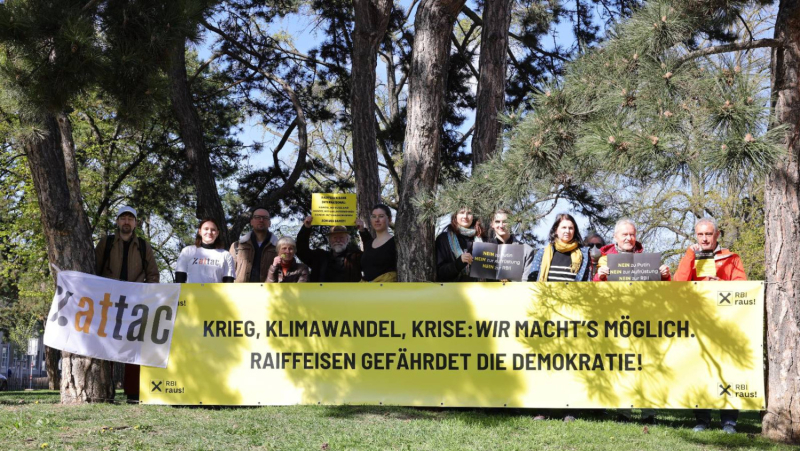
Raiffeisen Bank International (RBI)’s Annual General Meeting in Vienna today saw protesters inside and outside the meeting demand action from the bank on its links with Russia, fossil fuel finance and controversial military tech. While protesters outside noted that RBI’s business activities “endanger democracy,” activists inside the AGM demanded the bank leadership provide a realistic and timely plan for a full exit from the Russian market.
Attac, BankTrack, B4Ukraine and IFOR Austria were among the protest organisers.
See a gallery of photos from the AGM here (credit: Ingrid Ellhotka).
RBI, the largest international bank in Russia, was criticised over its continued large-scale ties to Putin’s war economy, as well as its financial exposure to the oil and gas sector and to US defence-tech firms such as Palantir. Protesters and investors called for RBI to immediately withdraw from Russia and to phase out investments in fossil fuels as well as in anti-democratic military and surveillance technology.
While chairman Erwin Hameseder lamented that a retreat from the Russian market presented a “Sisyphean task” for RBI, these excuses were met with significant pushback from investors. During the board’s opening speeches, a series of activist shareholders disrupted the day’s proceedings by loudly accusing the bank of “anti-democratic” financial activities.
Activists demanded answers over the bank’s ties to Russia and the fossil fuel industry, chanting “RBI, get out oil; RBI, get out of gas!”, and loudly objected to RBI’s investments in the surveillance and military conglomerate Palantir, which is regarded as an extension of the US security apparatus and undermines fundamental principles of data protection and democracy. During these protests, the meeting was brought to a temporary standstill several times.
Hanna Braun of Attac Austria, who coordinated the protest outside the AGM, said:
“Despite making a consolidated profit of €1.44bn last year, RBI continues to prioritise raising profit margins over peace, climate justice and fundamental democratic rights. And while the bank continues to profit from war, RBI’s Supervisory Board Chairman Erwin Hameseder is publicly calling for more arms proliferation, a loosening of arms export laws, and changes to EU regulation in order to classify climate-damaging arms investments as ‘sustainable.”
RBI still contributes to Putin’s war budget – although research shows an exit from Russia is feasible
Contrary to its promises to withdraw from the Russian market, RBI remains the largest international bank in Russia. Since 2022, it has paid around €1.9bn into Russia’s state budget via income taxes – around 30 per cent of which goes towards the Russian military budget. In 2025, an RBI subsidiary was found to have invested €335m in Russian companies such as Gazprom and Rosneft, as well as in Russian government bonds.
Meanwhile, a recent financial briefing by BankTrack, B4Ukraine and the KSE Institute demonstrates that withdrawing from Russia would actually be cheaper than the losses risked by staying.
Max Hammer of BankTrack, who challenged the bank inside its AGM on its continued presence in Russia, asked RBI’s leadership:
“RBI is still unnecessarily helping to finance Putin’s illegal war of aggression against Ukraine. This creates substantial risks both from a human rights and a financial perspective. Has RBI conducted heightened Human Rights Due Diligence in connection with its business activities in Russia? And why does the bank continue to cling to an unrealistic and unfeasible Russia exit strategy?”
Profiting from the climate crisis and surveillance
RBI remains one of Austria’s largest financiers of the fossil fuel industry. A report from Urgewald shows that between 2022 and 2024, RBI financed fossil fuel companies to the value of US$3.5bn. Of this sum, ca. US$1.7bn went to companies that continue to expand their fossil fuel projects – an increase of around 68 per cent over three years. In addition, RBI holds €232m in investments across more than 50 funds in expanding oil, gas and coal companies. Reports have also shown that the bank continues to process payments for the transfer of Russian pipeline gas to Europe – helping Russia export gas to the value of at least €7bn annually.
At the AGM, Urgewald’s Nicole Rath called attention to the bank’s insufficient exclusion policies in the oil and gas sector, demanding the bank expand its policy guidelines to exclude companies still expanding their oil and gas projects.
On the same day, B4Ukraine reported that pressure on Raiffeisen mounted in Ukraine, as the country’s top job platform Work.ua blacklisted RBI’s Ukrainian outlet, citing the RBI group’s continued ties to Russia’s war economy.