
Raiffeisen exit from Russia “significantly less costly” than risks of staying, new briefing paper shows
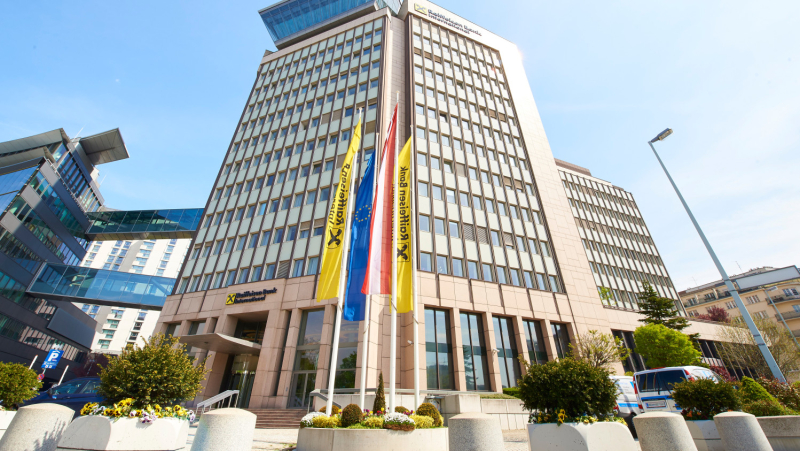
In advance of Raiffeisen Bank International (RBI)’s annual shareholders’ meeting in Vienna on Thursday, a new briefing paper suggests the bank may be exposing investors to substantial risks by failing to adequately manage its continued exposure to the Russian market.
The paper, by BankTrack, the KSE Institute of the Kyiv School of Economics, and B4Ukraine, models the costs and risks of RBI’s continued Russian presence and assesses potential exit options. It finds that RBI’s current Russia exit strategy is flawed compared to alternatives that the bank’s leadership has so far left apparently unexplored. These include a “business freeze” strategy (winding down all non-essential business) and a “dropping the keys” strategy (deconsolidating the Russian subsidiary and writing it down in its entirety as a loss).
Nezir Sinani, Executive Director of B4Ukraine, said:
“The lack of transparency around RBI’s business activities in Russia has long made it difficult to realistically assess its options for exiting the Russian market. This paper, however, makes the compelling case that leaving Russia would be advantageous not just from a human rights perspective, but for the bank and its shareholders as well. The analysis makes it clear that the time for RBI to sever its ties with Russia’s war economy is long overdue.”
RBI, which has come under widespread criticism for continuing to operate in Russia since the full-scale invasion of Ukraine, has repeatedly claimed it is seeking to exit Russia but cannot immediately do so due to restrictions on the sale of its local subsidiary. The subsidiary, AO Raiffeisenbank, operates a crucial payments pipeline in the Russian economy, and has generated record profits since the onset of the war. However, these profits are trapped in Russia due to Kremlin regulations.
While RBI has scaled back its business in Russia, reducing loan volumes and customer deposits substantially since 2024, it remains under pressure from civil society, investment groups, and national and international regulators to present a credible plan for exiting the country.
The new briefing demonstrates that there are alternatives to a sale of AO Raiffeisenbank. Drawing on years of research and financial modelling to assess the costs of RBI’s exposure to the Russian market and the costs of a potential exit, the paper finds that RBI retains several credible options for exiting the Russian economy.
These options would cost the bank between €4.1 and €5.6 billion, comparable or slightly above the likely loss from a sale of the bank’s Russian subsidiary. However, they would also carry substantial medium-term financial benefits for the bank and its investors that would “significantly ” the immediate costs of an exit, according to the paper.
This analysis is based on financial modelling of the potential losses risked by RBI’s continued exposure to the Russian market, which may exceed €5.6 billion and is estimated as having a downward impact of between 10 and 30% on the bank’s share trading price.
Released just before RBI’s 2026 Annual General Meeting (AGM) on 9th April, the paper’s findings may complicate RBI leadership’s claim that an exit from Russia is “not in hands”, as outgoing CEO Johann Strobl asserted recently. Incoming CEO Michael Höllerer, who is set to take over the reins in the summer, will likely face renewed pressure to accelerate the bank’s Russia exit. The briefing recommends that investors take specific steps to add to this pressure by demanding that RBI assess its options for leaving Russia and transparently communicate its intention to explore all available exit routes.
Max Hammer, Human Rights Campaigner at BankTrack and a co-author of the paper, said:
“This paper casts serious doubt on Raiffeisen’s continued claims that it is stuck in Russia without real options to leave. The data shows what we have been suspecting for years: leaving Russia is not just a moral obligation, it’s the right decision from a risk management perspective. Investors at the bank’s AGM should be asking serious questions about RBI’s failure to exit the Russian market – and placing pressure on RBI to make the right decision and fully explore all the options for a quick Russia exit.”
The briefing paper can be downloaded here.