
BANKS DODGY DEALS CAMPAIGNS
Sections
Banks Dodgy Deals Campaigns
Our campaigns
Banks and Climate
Banks and Human Rights
Banks and Nature
Our projects
Tracking the NZBA
Banks and Conflict Zones
Banks and Steel
Banks and Russia
Tracking the Equator Principles
Tracking the PRBs
Find a Better Bank
Banks and the OECD Guidelines
Media
News Publications Events calendar
Raiffeisen Out! Bank.Green End Coal Finance Plastic Banks Tracker Defund TotalEnergies Financial Exclusions Tracker Equator-Complaints.Org Don't Buy into Occupation Banks & Biodiversity Forests & Finance Drop JBS StopEACOP Fossil-Free Finance
BankTrack
About BankTrack Organisation Our team Our board Our annual reports Funding and finances Guiding principles Our history BankTrack in the media Team up with us Our privacy policy Donate Get in touch
Successes Contact BankTrack
Donate Mailing list Instagram Bluesky Linkedin Login
Home › Dodgy Deals ›
Dodgy Deal
Burapa Power PlantThailand

Project – Active

This profile is actively maintained
Profile by:
Accountability Counsel & Solutions for Our Climate
Work partners:
Chachoengsao RePower & Fossil Free Thailand
Contact:

info@accountabilitycounsel.org; solutions@forourclimate.org

Last update: 2026-03-30 14:46:14
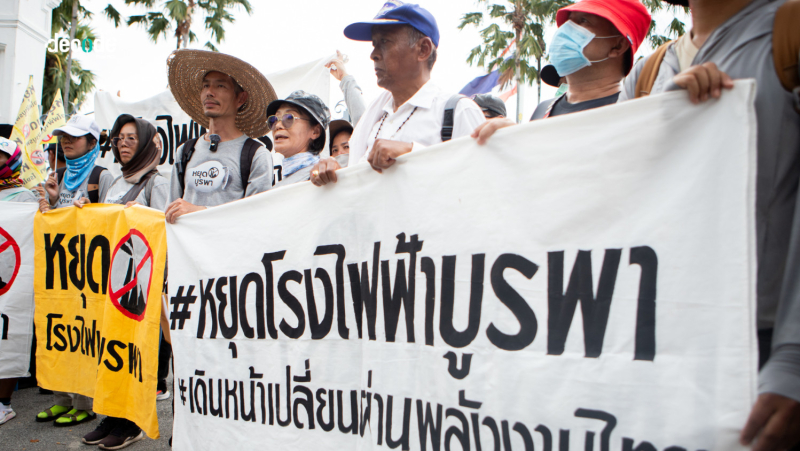
Demonstration in Thailand against the Burapa Power Plant and for an energy transition, November 2025. Photo: Decode ThaiPBS

Project – Active

This profile is actively maintained
Profile by:
Accountability Counsel & Solutions for Our Climate
Work partners:
Chachoengsao RePower & Fossil Free Thailand
Contact:

info@accountabilitycounsel.org; solutions@forourclimate.org

Last update: 2026-03-30 14:46:14
Why this profile?

Why this profile?

The Burapa Power Plant is marked by unresolved community, environmental, social and economic concerns, active legal disputes over transmission lines, and inadequate public participation in environmental assessments. These risks are exacerbated by concerns over the use of Strategic Litigation Against Public Participation (SLAPP) by the project developer to silence critics, raising serious human rights concerns and restrictions on freedom of expression. Furthermore, the project relies on outdated EIA, and there is a lack of transparency around the Power Purchase Agreement and regulatory approvals prematurely granted despite ongoing investigations. 

What must happen

  1. Financial institutions, including commercial banks, should not provide direct or indirect support for this project. Banks should ensure that their investments are in line with the UN Guiding Principles on Business and Human Rights (UNGPs) and other international standards. 

  2. The Thai government should urgently place this project on hold and appoint an inquiry committee to review the validity and legitimacy of the Energy Regulatory Commission (ERC) process to grant its energy operation licence.  It should also order the developer to commission a Strategic Environmental and Social Impacts Assessment of the Project that includes a full-lifecycle greenhouse gas emissions assessment and a Carrying Capacity Assessment.

About
Sectors Gas Electric Power Generation
Location
Status
Planning
Design
Agreement
Construction
Operation
Closure
Decommission

The Burapa Power Plant Project is a proposed 540 MW fossil gas-fired combined cycle power plant, under construction in Khao Hin Son, Phanom Sarakham, Chachoengsao Province, Thailand. It is a controversial project with a long history of regulatory and community disputes. The project originated in 2007 as a 600 MW coal-fired power plant awarded to Advance Agro (now Double A Power/National Power Supply, NPS). It faced sustained local opposition and repeatedly failed to secure official approval, including four rejected Environmental and Health Impact Assessments (EHIAs), most recently in 2016. Despite this, the project continued to reappear in Thai  National Power Development Plans (PDPs). 

In 2019, the coal proposal was effectively rebranded as the 540 MW Burapa natural gas-fired power plant at the same site. The Project developers signed a 25-year Power Purchase Agreement (PPA) with the Electricity Authority of Thailand (EGAT) and a long-term gas supply agreement with PTT PCL. The project was initially expected to begin commercial operation by 2027, but has since been ordered by the government to delay its scheduled commercial operation date to 2029 due to Thailand’s overcapacity issues.

Impacts

Impact on human rights and communities

The project has raised serious and persistent human rights concerns affecting local communities. Local residents have reported inadequate access to information and barriers to meaningful public participation throughout the project’s development, particularly during the environmental impact assessment, which took place during the Covid-19 pandemic. Affected community members stated that they were not properly informed or able to fully participate in public hearings, undermining the principles of inclusive and meaningful public participation required under Thailand’s environmental governance frameworks.

The construction of associated infrastructure, including electricity transmission lines connecting the power plant to nearby electricity substations, has adversely affected landowners and their livelihoods. At least three separate lawsuits have been filed and accepted by Thailand’s Administrative Court, alleging, among other issues, the inadequate compensation of land acquisition, land rights restrictions under the Right of Way, and the absence of meaningful stakeholder consultation when the transmission lines were planned. 

Severe freshwater supply constraints present an additional and critical human rights risk for small-scale farmers and the public, especially vulnerable populations that need access to public facilities in Chachoengsao, such as schools and hospitals. The project is expected to extract approximately 12,000 cubic meters of fresh water per day, primarily for cooling the power plant. This water will be supplied by Industrial Water Supply Co., Ltd, which is only permitted to pump water from Khlong Rabom, a tributary stream flowing into Bang Pakong River, the main river of Chachoengsao, for four months of the year (July to October). However, Chachoengsao province already faces chronic water scarcity. As of September 2023, the province’s major reservoirs held less than 20% of total capacity, while water demand from agriculture, domestic consumption, ecosystems and industry already far exceeds available water supply. Khlong Rabom and Klong Sri Yat, the connected water systems, are already heavily utilised by industrial users and provincial waterworks. The project’s additional water demand is therefore likely to intensify tension over scarce but essential resources, heightening the risk of water shortages and resource conflicts that directly affect local livelihoods and ecosystem sustainability.

Public health risks further compound community concerns. Gas-fired power generation emits air pollutants such as nitrogen oxides (NOx) and fine particulate matter (PM2.5), which are linked to respiratory and cardiovascular diseases. Given the project’s proximity to residential areas and the lack of baseline health data surveys and regular oversight, communities fear long-term health impacts, particularly for vulnerable groups.

The Power Purchase Agreement (PPA) for the Burapa Power Project has not been publicly disclosed, despite PPAs being considered public documents, raising serious questions about transparency and accountability. Furthermore, the approval of energy operation licences ahead of proposed field visits promised by the ERC undermines due process and erodes public trust in regulatory institutions. The regulatory approvals were granted despite ongoing investigations and unresolved complaints from direct stakeholders, including litigation cases before the Administrative Court, inquiries by the National Human Rights Commission of Thailand and a petition to the Senators’ Sub-committee on Agriculture and Cooperatives. 

Beyond local impacts, the project is situated within a broader context of shrinking civic space and fear of retaliation. Companies associated with the project operator, particularly GULF Development PCL, have been widely criticised for their use of Strategic Litigation Against Public Participation suits (SLAPPs) against activists, academics, and politicians. These lawsuits have been condemned by civil society and human rights organisations as attempts to silence dissent, creating a chilling effect on freedom of expression and public participation. 


Impact on climate

Financing the Burapa Power Project is fundamentally misaligned with Thailand’s climate commitments and exposes investors and lenders to significant transition and financial risks. Recent financial analyses indicate that up to 67% of Thailand’s fossil fuel power capacity could become stranded by 2040, with potential stranded-asset losses reaching 530 billion THB under a full renewable transition scenario. As a large, long-lived gas-fired power plant, Burapa Power Plant is particularly vulnerable to these risks in a rapidly shifting energy landscape marked by persistent power overcapacity, declining competitiveness of fossil gas, and accelerating deployment of renewable energy.

Thailand already faces a substantial electricity surplus, with many existing power plants operating far below their intended utilization rates. As renewable generation expands and energy efficiency improves, fossil fuel plants are increasingly underused, raising serious doubts about the long-term viability of new gas capacity. If constructed, this project risks becoming an under-utilized or idle asset that delivers limited returns while locking financiers into long-term debt exposure.

These risks are compounded by Thailand’s growing reliance on imported liquefied natural gas (LNG), which has significantly increased electricity costs. In 2022, surging fuel prices contributed to a 150 billion THB liquidity crisis at EGAT, severely limiting the utility’s ability to absorb further fuel-related losses. With continued political pressure to lower electricity prices and public concern over affordability, policymakers are likely to accelerate alternatives to LNG, further undermining the economic case for new gas power plant projects.

At the same time, Thailand has advanced its national net-zero target by 15 years—from 2065 to 2050—under its third Nationally Determined Contribution (NDC), alongside a commitment to reduce emissions by 47% from 2019 levels by 2035. Given the typical 20–25 year lifespan of gas power plants, investing in this project today would lock Thailand into fossil fuel dependence well beyond the timeframe compatible with a 1.5°C pathway, directly contradicting national climate and energy transition objectives.


Impact on nature and environment

This project is a combined-cycle gas-fired power plant that uses natural gas as its primary fuel. Although often misleadingly portrayed as a “cleaner” fossil fuel, gas combustion releases harmful air pollutants, particularly sulfur dioxide (SO₂) and nitrogen dioxide (NO₂), which can have serious environmental and health impacts.

The combustion of fossil gas releases greenhouse gases (GHGs), contributing to climate change, as well as harmful air pollutants such as SO₂ and NO₂. These pollutants have direct and well-documented negative impacts on agriculture and human health. SO₂ and NO₂ can damage plant tissue, cause leaf burn, weaken crops, and increase vulnerability to disease, ultimately lowering agricultural yields over time.

According to the project’s EIA, environmentally sensitive areas are defined as areas within a 5-kilometre radius of the project covering three sub-districts: Koh Khanun, Khao Hin Son, and Khoo Yai Mee. Data from the Ministry of Agriculture and Cooperatives show that these three subdistricts contain more than 123,000 rai of economic crops, including rice, cassava, and rubber plantations, with a combined annual economic value exceeding 1.14 billion baht.

Beyond staple crops, the area is also a major production zone for mangoes, a key income-generating fruit of Chachoengsao Province. In particular, Nam Dok Mai mango, registered as a Geographical Indication (GI) product, generated over 14,000 tons of output last year with an estimated value of 518 million Baht annually. The surrounding area also includes well-known organic farming zones, located just 5.74 kilometers from the project site. 

Air pollution from the project may therefore threaten not only livelihoods and food security, but also the long-term viability of organic and GI-certified agriculture in the region.

In addition to SO₂ and NO₂, gas-fired power plants are a significant source of nitrogen oxides (NOx) and fine particulate matter (PM2.5). NASA has identified NO₂ as a key indicator of pollution from fossil fuel combustion. In the atmosphere, NO₂ and SO₂ undergo chemical reactions that form PM2.5—fine particles that can penetrate deep into the lungs and bloodstream. Exposure to PM2.5 is strongly linked to serious non-communicable diseases, including ischemic heart disease, stroke, chronic obstructive pulmonary disease (COPD), asthma, and cancer.

Health risks are further intensified by the operating characteristics of gas power plants. Facilities like this project frequently ramp up and down to meet peak electricity demand, leading to incomplete combustion during startups and shutdowns, which increases pollutant emissions. 

Financiers

There is no publicly disclosed information available on the project finance or whether a final investment decision (FID) has been reached, and which financial institutions, if any, are involved.

Shareholders

It is officially recorded that UBS AG, a Swiss bank, is one of the largest shareholders of GULF Development PCL. Throughout 2025, the local communities have engaged with UBS AG through multiple channels, including its AGM, email correspondence, and face-to-face meetings. 

Commercial Banks

In parallel, we have been communicating with a list of potential commercial bank financiers of Burapa Power Project, identified based on their past financial support for GULF power plant developments in Thailand. To date, four banks have confirmed that they are not involved in the project:

  • TMBThanachart

  • Standard Chartered

  • Bank of Ayudhya (verbal confirmation)

  • Kasikornbank (verbal confirmation)

Four banks stated that they are unable to disclose any information due to confidentiality obligations:

  • Mizuho

  • Sumitomo Mitsui Financial Group (SMFG), which overseas SMBC and Sumitomo Mitsui Trust Bank

  • Société Générale

  • Natixis

Bonds

GULF PCL has regularly issued a series of corporate bonds to raise funds for its operation. In 2025, the following banks are listed as underwriters of GULF PCL’s corporate bonds:

  • Bank of Ayudhya (Krungsri)
  • Bangkok Bank (BBL)
  • SCB, Kasikornbank (KBANK) 
  • Krung Thai Bank
  • TMBThanachart
  • Kiatnakin Phatra
  • CIMB
  • Maybank
  • UOB
Institution type
Finance type
Year
Companies

Project sponsors

Gulf Development Public Company Limited

Thailand
Website
Owns 35% of Burapa Power Holding Company Limited, the project operator

National Power Supply Public Company Limited

Thailand
Website
Owns 65% of Burapa Power Holding Company Limited, the project operator
No companies
Governance
Bank policies
Norms & standards

1. Principles for Responsible Banking 

Through financing the Burapa Power Project, the Banks risk contributing to potential violations of the Principles for Responsible Banking.

  • Principle 1: Alignment: Financing the project would lock the banks in long-term fossil gas infrastructure, making it difficult for banks to achieve Paris-aligned net-zero targets. Financing any new gas infrastructure is not compatible with the Paris Climate Agreement. 

  • Principle 2: Impacts and Target Setting: Banks’ failures to prevent or address adverse human rights impacts that are directly linked to the banks’ business relationship with business entities that allegedly use SLAPPs to intimidate and restrict the freedom of expression of critics.

  • Principle 4: Stakeholders: Banks’ failure to proactively and responsibly conduct meaningful consultation with the affected community members who are direct stakeholders of the project.

  • Principle 6: Transparency and Accountability: Banks' failure to be transparent and accountable for both positive and negative impacts, in particular, the lack of responses to social and environmental concerns raised by community members demonstrates a discrepancy in banks’ commitment to transparency and accountability.

2. UN Guiding Principles on Business and Human Rights 

Through financing the Burapa Power Project, the Banks risk contributing to potential violations of the UNGPs.

  • Principles 11 and 12: Banks should respect human rights, meaning that banks should avoid infringing on the human rights of others and should address human rights impacts that they are involved in. In this context, 'human rights' refers to internationally recognized human rights, including the rights to a healthy environment, the rights to health, the rights to social, cultural, and economic rights and land rights. If banks finance the Burapa Power Project, which has already faced strong opposition from local communities because of its negative impacts on environment, economic and livelihood, and land rights, they have failed to avoid and address human rights impacts of the project.

  • Principle 13: Under these principles, banks are required to avoid causing or contributing to adverse human rights impacts, to prevent and mitigate adverse human rights impacts that are linked to their operations by their business relationships, even if they have not contributed to those impacts. Providing financial products and services to companies that have an ongoing record of filing civil and criminal lawsuits to intimidate and silence critics implies that banks are contributing to and failing to mitigate adverse human rights impacts through their business relationships.

  •  Principle 17: Through financing this project, banks may have failed to carry out thorough and comprehensive human rights due diligence to identify human rights risks and adverse human rights impacts that this project has allegedly contributed to; for example, an inadequate public consultation with stakeholders on environmental and social impacts assessment; a lack of transparency of the project information and permits approval process; and a mitigation plan to respond to concerns over the use of SLAPP lawsuits to intimidate legitimate critics.

  • Principle 18: Banks should identify and assess any actual or potential adverse human rights and environmental impacts by conducting meaningful consultation with potentially affected groups and other relevant stakeholders. The fact that local residents have to file administrative lawsuits on the land disputes over the transmission lines, and have submitted a complaint to the National Human Rights Commission – which prompted an inquiry into their concerns – should already raise the alarm for banks to review their business relationships with the project developers.

  • Principle 21: Banks should communicate externally, especially when concerns are raised by the affected stakeholders. Banks should report formally and provide sufficient information to evaluate the adequacy of their response to particular human rights impacts. The Fossil Free Thailand sent letters of concern here and here to multiple commercial banks that have supported the project developers in the previous fossil fuel projects. Only five banks formally replied, and some did not provide sufficient information to adequately respond to community questions and concerns.

  • Principle 22: There is currently no binding agreement among the commercial banks and private investors to mandate an effective grievance mechanism is available for the affected stakeholders.

3. Equator Principles 

Through financing the Burapa Power Project, the banks risk contributing to potential violations of Equator Principles 2,3,4,5,6 and 10.

Principle 2 (Environmental and Social Assessment) and Principle 3 (Applicable Environmental and Social Standards):

We consider the Burapa Power Plant as a Category A project, with potential significant adverse environmental and social impacts that are irreversible and unprecedented. Therefore, the banks should make sure that the project developers are required to conduct adequate, accurate, objective, and up-to-date Environmental and Social Impact Assessment (ESIA) with reference to the UNGPs and Climate Change Risk Assessment. The banks are tasked to make sure that the project developer assessed the project's human rights and social risks and their compliance with national regulations and international standards, including the IFC Performance Standards on Environmental and Social Sustainability and the World Bank Group Environment, Health and Safety Guidelines. 

  • Despite these commitments, the communities raised questions about both the substance of the Project EIA which relied on outdated information on the country's electricity generating capacity and did not identify alternative power generation such as wind and solar farms. 

  • The EIA did not include the Cumulative Impacts Assessment as the industrial infrastructure expansion has rapidly increased in the past decade and contributes to higher levels of pollutants and resource conflicts. 

  • The preparation of the EIA also lacks meaningful and adequate public consultation with directly affected stakeholders. For example, community members who have spoken publicly against the Project were not included or invited to the public consultation. 

  • The EIA did not include an assessment of potential climate risks and gave an incomplete overview of potential human rights impacts on public health from the pollutants and greenhouse gas emissions of the project. 

  • The EIA did not include comprehensive socio-economic data. The livelihoods and incomes of communities depend on small-scale agriculture, but the project EIA did not address nor discuss the release of greenhouse gas that will affect agricultural products and their ability to generate viable livelihood.

  • The project's EIA did not address the potential constraints over the water supply and the resource tensions between community consumption and industrial use. The Project’s EIA stated that the power plant required a significant amount of fresh water for cooling the system every day but did not estimate what are mitigation measures during the drought and dry season where local tributaries and reservoirs dry up. 

Principle 4 (Environmental and Social Management System and Equator Principles Action Plan): 

Project developers should adopt and develop the Environmental and Social Plan to fully address all communities' concerns in line with the applicable standards. For this project, which is located in Thailand, a non-designated country as categorised by the Equator Principles, the IFC Performance Standards on Environmental and Social Sustainability and the World Bank Group Environment, Health and Safety Guidelines are applicable. 

Principle 6 (Stakeholder Engagement):

Under this Principle, for a Category A Project, the developers are required to conduct an informed consultation and participation process. The consultation and participation process should be tailored to the risks and impacts of the Project, decision-making process of the affected communities, and the needs of disadvantaged and vulnerable groups. According to the Notification of the Ministry of Natural Resources and Environment on 24 April 2012, it is mandatory for the developer of a thermal power plant with the capacity of electricity generating higher than 10 MGW to conduct an EIA and obtain an energy industry operation licenses from the regulatory bodies. In addition, under the Energy Industry Act 2007, the ERC is obligated to promote the rights and liberties of energy consumers and local communities; to promote the efficient use of energy and resources with due consideration of environmental impacts and balance of natural resources; to promote an effective participation of local communities. In issuing the license, the ERC must take into account the impacts on people, worthiness in economic, social and investment aspects.

Despite the domestic regulations’ requirements, the participation and consultation process in consideration of this Project’s EIA process, an energy operation license process has been inadequate. For instance, in the process leading up to the approval of the license of this Project, the Energy Regulatory Commission (ERC), on 15 October 2026, granted the operational permits to the developers without conducting a field visit nor an inclusive public hearing as repeatedly requested by the affected communities. 

Furthermore, on 24 December 2026, the affected community members raised concerns at the public hearing process organized by the developers who revised the substantive details of the EIA without commissioning a new study. Community members expressed that the EIA consultation process was conducted during the COVID-19 pandemic, hence the affected community were unable to meaningfully participate. Meanwhile, the revision of the EIA indicated that the Project developers plan to use dangerous chemicals such as ammonia in the operation process but did not provide a study on potential leakage and the cumulative impacts on the contribution to PM2.5 pollution. 

Principle 10 (Grievance Mechanism):

Under this Principle, the Project developers are required to establish an effective and accessible grievance mechanism to receive and facilitate resolutions of concerns from affected communities, workers, and other stakeholders about the Project’s environmental and social performance. The developers of the Project, stated in the Preventative and Corrective Measures on Environmental Impacts, and the Environmental Impacts Monitoring Measures, that it will document concerns raised by affected communities, identify measures to resolve the grievances, and timeline of the implementation from representatives of households living in the 5 km of the power plant every six months throughout the Project’s cycle. The developer promised to disseminate information about the communication channels for community members to raise their concerns. However, there is no specific indication of the establishment of a formal project level grievance mechanism nor a procedure, and timeline of how community grievances will be investigated and resolved. 

Despite the formal letters from the affected communities in which they requested to meet with the representatives from GULF PCL and NPS PCL, the Project’s developers on 6 October 2025 to discuss their concerns on environmental and social impacts. The two Project developers did not officially respond nor accept the meeting requests. This demonstrates the Project developers have yet to show their willingness to adequately and timely address and communicate with the affected communities.

4. Stock Exchange of Thailand (SET) ESG rating

  • Links to the use of SLAPPs via the Project Developer undermine ESG credibility by signaling poor human rights practices, weak stakeholder engagement, and inadequate governance oversight, all of which are core components of SET’s ESG assessment framework.

Applicable norms and standards

Equator Principles
Principles for Responsible Banking (PRB)
UN Guiding Principles on Business and Human Rights
News
BankTrack
Partners
Blog
External
BankTrack news BankTrack blog Partner news Partner blog

ลุ่ม “น้ำ” บางปะกง กับโรงไฟฟ้าบูรพา

The Bang Pakong River Basin and the Burapha Power Plant
2026-01-26 | Sarakadee Magazine
BankTrack news BankTrack blog Partner news Partner blog

เสียงจากเขาหินซ้อนในวันที่ ‘โรงงานไฟฟ้า-อุตสาหกรรม’ รุกคืบพื้นที่ทำกิน

Voices from Khao Hin Son on the day 'power plants and industries' encroach on farmland
2026-01-20 | The Matter
BankTrack news BankTrack blog Partner news Partner blog

เสียงประชาชนรอบ ‘โรงไฟฟ้าบูรพา’ เมื่อขั้นตอนก่อสร้าง-การมีส่วนร่วมมีปัญหา ท่ามกลางการผลิตไฟฟ้าที่ล้นเกินแผน PDP

Public voices surrounding the Burapha Power Plant: Problems with construction and public participation amidst electricity production exceeding the PDP plan
2026-01-16 | The Momentum
BankTrack news BankTrack blog Partner news Partner blog

“การปรับเปลี่ยนโครงการ-ผลกระทบ-เวทีรับฟัง” โรงไฟฟ้าบูรพาพาวเวอร์

"Project Modifications - Impacts - Public Hearings": Burapha Power Plant
2025-12-24 | Green News
BankTrack news BankTrack blog Partner news Partner blog

โรงไฟฟ้าบูรพาฯ : ถามหา ‘สิทธิชุมชน’ เมื่อการพัฒนายังมองไม่เห็นผู้คนในสมการ ?

Burapha Power Plant: Questioning ‘Community Rights’ When Development Fails to Include People in the Equation?
2025-12-24 | The Active, Thai PBS
BankTrack news BankTrack blog Partner news Partner blog

รายงาน EIA โครงการโรงไฟฟ้าบูรพาพาวเวอร์ : เอกสารตกยุค

Burapha Power Plant Project's EIA Report: An Outdated Document
2025-12-20 | Climate Connectors
BankTrack news BankTrack blog Partner news Partner blog

โรงไฟฟ้าก๊าซบูรพาฯ กับอนาคต Net Zero 2050 เมื่อพลังงานไม่เปลี่ยนผ่าน

The Burapha Gas Power Plant and the Net Zero 2050 Future: When Energy Transition Fails
2025-11-22 | Thai Public Broadcasting Service
BankTrack news BankTrack blog Partner news Partner blog

เสียงจากชุมชน: โรงไฟฟ้าก๊าซบูรพาพาวเวอร์และ 18 ปีของการเปลี่ยนผ่านพลังงานที่ไม่เคยเป็นธรรม

Voices from the Community: Burapha Power Gas Power Plant and 18 Years of Unfair Energy Transition
2025-11-18 | Greenpeace Thailand
BankTrack news BankTrack blog Partner news Partner blog

มหากาพย์ไทม์ไลน์โรงไฟฟ้าบูรพาพาวเวอร์ ฉะเชิงเทรา

The Epic Timeline of Burapha Power Plant, Chachoengsao
2025-11-17 | Epigram News
BankTrack news BankTrack blog Partner news Partner blog

ยื่นร้องนายกฯ หยุด "โรงไฟฟ้าบูรพาพาวเวอร์"

Petition submitted to the Prime Minister to halt "Burapha Power Plant" construction
2025-11-11 | Thai News Agency
BankTrack news BankTrack blog Partner news Partner blog

จากฉะเชิงเทรา สู่ทำเนียบรัฐบาล กว่า 125 กิโลเมตร 2 เท้าก้าว 1 ความหวัง 6 วันเดิน ยืนหยัดคัดค้านโรงไฟฟ้าบูรพาฯ

From Chachoengsao to Government House: Over 125 kilometers, two steps, one hope, six days of walking, standing firm in opposition to the Burapha Power Plant
2025-11-06 | มูลนิธิสืบนาคะเสถียร
BankTrack news BankTrack blog Partner news Partner blog

Stop Burapha Power Plant, March for Thailand’s Just Energy Transition

2025-11-05 | Energy Shift Southeast Asia
BankTrack news BankTrack blog Partner news Partner blog

กลุ่มฉะเชิงเทรารีพาวเวอร์ รณรงค์หยุดโรงไฟฟ้าบูรพาพาวเวอร์

Chachoengsao Repower Group campaigns to stop Burapha Power Plant
2025-11-01 | ประชาไท
BankTrack news BankTrack blog Partner news Partner blog

ภาคประชาชนค้านโรงไฟฟ้าบูรพาพาวเวอร์ในฉะเชิงเทรา ชี้ละเมิดสิทธิชุมชน-กระทบสิ่งแวดล้อม

Civil society groups oppose the Burapha Power Plant project in Chachoengsao, citing violations of community rights and environmental impacts
2025-05-27 | C-Site, Thai PBS
BankTrack news BankTrack blog Partner news Partner blog

“You are financing destruction”: Southeast Asian advocates confront UBS for backing fossil fuel expansion

2025-04-15 | Energy Shift Southeast Asia
Resources
Documents
2025-09-30 00:00:00

Letter from five CSOs to UBS on fossil fuel financing

Open letter to UBS to end its fossil fuel financing, from BreakFree Suisse, Center for Energy, Ecology, and Development, Energy Shift Southeast Asia, Japan Center for a Sustainable Environment and Society (JACSES), and Solutions For Our Climate
Correspondence
2025-09-30 00:00:00 | five CSOs
2025-11-05 00:00:00

Letter from Fossil Free Thailand to Banks on urgent concerns regarding Burapa Power Project in Thailand

To Bank of Ayudhya, Bank of China, Government Savings Bank, ICBC, Kasikorn Bank, Mizuho, Natixis, SMBC, Societe Generale, Standard Chartered, Sumitomo Mitsui Trust
Correspondence
2025-11-05 00:00:00 | Fossil Free Thailand
Updates

2026

2026-03-30 00:00:00 | Final Investment Decision reported

According to National Power Supply Company (NPS)’ Financial Report, P42,  published earlier this month, the Final Investment Decision on the project has been reached. On 20 October 2025, Burapha Power Generation Co., Ltd., a subsidiary of Burapha Power Holding Co., Ltd. — which is a joint venture of the Company — entered into loan agreements with two financial institutions, with a total facility amount of THB 20,310 million. As of 31 December 2025, the joint venture had drawn down THB 2,116 million under these facilities. The loan agreements have a repayment term of 24 years from the date of the first drawdown, with the first principal repayment scheduled to begin in 2030. The loans carry an interest rate of THOR plus 2% per annum and are intended to finance the construction of a power plant.

Under the loan agreements, there are financial covenants that must be complied with. These include requirements for Burapha Power Generation Co., Ltd. to maintain specified debt-to-equity and debt service coverage ratios, in accordance with the terms set out in the agreements. In addition, the Company is required to maintain its shareholding in Burapha Power Holding Co., Ltd.—the joint venture—at the level specified in the agreements.

Send feedback on this profile
Sections
Banks Dodgy Deals Campaigns
Our campaigns
Banks and Climate Banks and Human Rights Banks and Nature
Our projects
Tracking the NZBA Banks and Conflict Zones Banks and Steel Banks and Russia Tracking the Equator Principles Tracking the PRBs Find a Better Bank Banks and the OECD Guidelines
Media
News Publications Events calendar
Raiffeisen Out! Bank.Green End Coal Finance Plastic Banks Tracker Defund TotalEnergies Financial Exclusions Tracker Equator-Complaints.Org Don't Buy into Occupation Banks & Biodiversity Forests & Finance Drop JBS StopEACOP Fossil-Free Finance
BankTrack
About BankTrack Organisation Our team Our board Our annual reports Funding and finances Guiding principles Our history BankTrack in the media Team up with us Our privacy policy Donate Get in touch
Successes Contact BankTrack
Nijmegen
The Netherlands
Contact us
Donate Mailing list Instagram Bluesky Linkedin
© BankTrack
BankTrack is a registered charity in the Netherlands (ANBI) - RSIN 813874658
Find our privacy policy here

To make BankTrack.org work, we place cookies on your device. You can accept all cookies, or decline optional cookies that enable us to show social media content, embedded content and track user analytics and Google ad campaigns. Read our privacy policy for a full disclosure of how we collect data and use cookies.

Stay up to date

Sign up now for all BankTrack's news


Make a comment

Your comment will be reviewed, before being posted